














Are Modern Poker Tournaments Too Long? Why Fast-Fold MTTs Deserve a Comeback

Updated: Sep 3

There was a time when I absolutely loved grinding online MTTs.
Today?
I barely play them.
Not because I enjoy tournament poker any less.
Quite the opposite.
I simply can’t justify spending 10 to 12 uninterrupted hours in front of a monitor anymore. And if I somehow survive Day 1, there’s a good chance I still have to come back the following day.
I’m far from the only one.
Talk to almost any former online grinder who now has a full-time job, a family or simply other commitments, and you’ll hear the same thing.
Modern MTTs ask for too much time.
Poker rooms recognised this problem years ago.
The mistake, in my opinion, is how they chose to solve it.
Today’s tournaments are usually made shorter by making players shorter.
Faster blind levels.
Shallower effective stacks.
Earlier all-ins.
Less post-flop poker.
More variance.
More than fifteen years ago, Full Tilt Poker experimented with a completely different philosophy.
Instead of making tournaments shorter by removing poker, it made them shorter by removing waiting.
That format was called Rush Poker Tournaments.
Looking back today, I genuinely believe the poker industry solved the wrong problem.
📖 Table of Contents
❓ FAQ
🚀 What Were Fast-Fold Tournaments?
When Full Tilt Poker launched Rush Poker in 2010, it wasn’t just introducing another poker variant.
It was introducing a completely different way of thinking about online poker.
The concept was brilliantly simple.
Instead of waiting for the current hand to finish, the moment you folded, you were instantly moved to a brand-new table with a new hand already waiting for you.
No watching the action.
No waiting for the dealer.
No sitting through thirty-second tanks after you’ve already folded preflop.
Just… poker.
Players could see up to four times more hands per hour than in a traditional game, making Rush one of the biggest innovations online poker had ever seen. A few months later, the same concept was successfully brought to multi-table tournaments, while the final table reverted to a traditional format.
At first glance, it looked like a speed gimmick.
It wasn’t.
Rush Poker wasn’t designed to make poker faster.
It was designed to eliminate everything that wasn’t poker.
That distinction changes the entire conversation.

⏳ Are Modern MTTs Too Long?
I think they are.
And I don’t think I’m alone.
The average online tournament has gradually become longer and longer over the years.
To compensate, operators have introduced faster structures, turbo formats, hyper turbos and increasingly aggressive blind schedules.
The intention is understandable.
Players don’t always have twelve hours available.
But here’s the problem.
Modern poker usually shortens tournaments by compressing the game itself.
The average stack gets shallower.
Blind pressure arrives sooner.
Post-flop play disappears earlier.
The number of forced all-ins increases.
In other words, tournaments finish earlier because there is less poker left to play.
Rush Poker attacked exactly the same problem…
…from the opposite direction.
Instead of asking:
“How do we eliminate players faster?”
it asked:
“How do we eliminate waiting?”
That’s a completely different philosophy.
Imagine spending three hours in a modern MTT.
You’re often navigating 25 or 30 big blinds, looking for reshove spots and trying to survive escalating blind levels.
Now imagine spending three hours in a Rush Tournament.
You haven’t simply played for three hours.
It feels like you’ve already played an entire tournament.
Not because the structure was faster.
Because you actually played poker almost the entire time.
That’s the difference.
Modern tournaments compress poker.
Rush Poker compressed time.
And once rebuys entered the picture, the contrast became even more remarkable.

💰 Deep-Stack Poker Without Spending Twelve Hours
This is where Rush Poker Tournaments stopped being just a clever gimmick and became, in my opinion, the best MTT format ever created.
Most players remember the fast-fold mechanic.
Very few remember the rebuy tournaments.
And that’s a shame, because this is where the format truly separated itself from everything we have today.
The first hour was complete madness.
Players weren’t protecting their starting stack.
They were building.
One rebuy.
Then another.
Some players fired 10 rebuys.
Others 15.
In the biggest events, seeing someone invest twenty or more buy-ins during the rebuy period wasn’t unusual.
Then came the break.
Almost everyone clicked the add-on.
Every rebuy and every add-on added more money directly to the prize pool, so the tournament kept getting bigger as the rebuy period progressed.
The result?
Prize pools exploded.
You could register what looked like a relatively small tournament…
…and two hours later be playing for several times more money than you initially expected.
That created an incredible atmosphere.
Every rebuy mattered.
Every add-on mattered.
The tournament kept growing before your eyes.
But the really brilliant part wasn’t the prize pool.
It was what happened to the chip stacks.
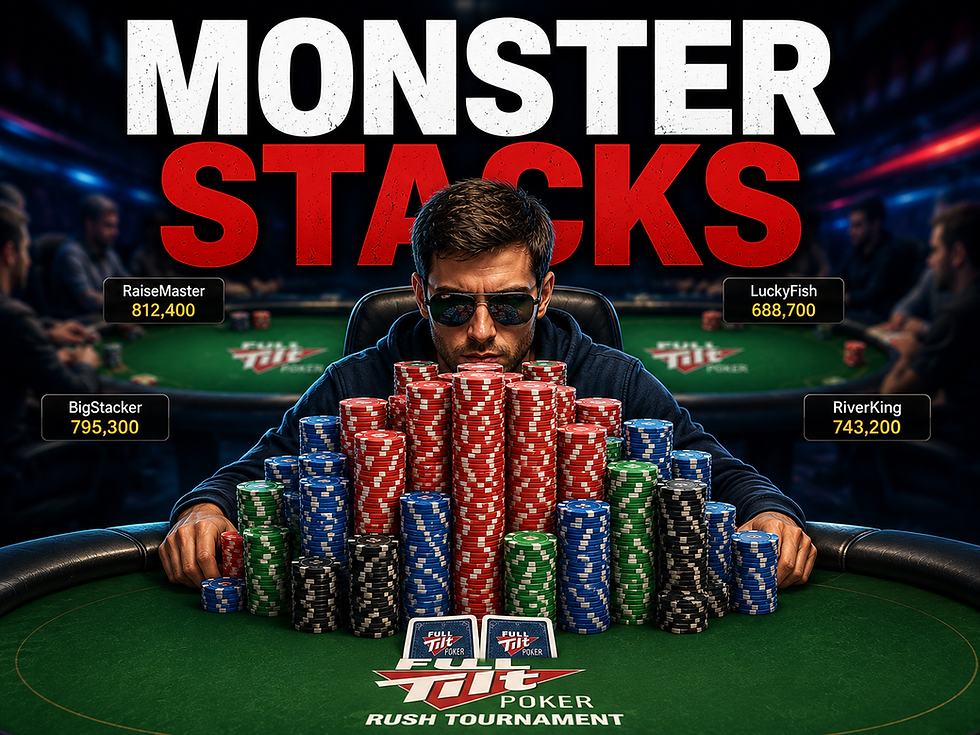
By the end of the rebuy period, tables were full of monster stacks.
Not because the tournament had already been running for ten hours.
Because thousands upon thousands of chips had entered play through rebuys and add-ons.
Looking around the table, seeing players sitting behind mountains of chips felt completely normal.
And somehow…
the tournament was still only a few hours old.
What made Rush revolutionary wasn’t that players had huge stacks.
It was how quickly they got there.
After three hours, it genuinely felt like you had already played an entire tournament.
Not because the structure was fast.
Because you had barely stopped playing.
You folded.
New table.
New hand.
Fold again.
Another table.
Another hand.
Hour after hour.
Almost every minute was spent making poker decisions instead of waiting for somebody else to act.
That’s the key difference modern poker still hasn’t replicated.
Today, after three hours in many online MTTs, you’re often navigating 25 or 30 big blinds.
The structure has accelerated.
Players have been eliminated.
The tournament is becoming shallower.
In a Rush rebuy tournament, after those same three hours, you could still be sitting behind an enormous stack with plenty of room for deep post-flop poker.
Modern tournaments compress the game.
Rush compressed the downtime.
Those are completely different philosophies.
To me, that’s the biggest lesson the industry forgot.
There’s another comparison I often think about.
An eight-hour session of Rush Tournament poker genuinely felt like you’d experienced what today often requires a multi-day event.
Not because the tournament literally lasted two days.
Because of the sheer amount of poker you played.
The number of hands.
The number of decisions.
The number of meaningful situations.
Everything was compressed into a single evening.
You could finish the session feeling like you’d lived an entire tournament series…
…without sacrificing the deep-stack poker that makes tournaments so enjoyable in the first place.
That’s exactly why I almost never play traditional MTTs anymore.
It’s not because I stopped loving tournament poker.
It’s because I can’t justify dedicating an entire day—or sometimes two days—to a single event.
Rush respected my time.
Modern tournament structures often don’t.
💵 Bigger Prize Pools, Bigger Dreams
Fast-fold tournaments didn’t just change the pace of the game—they also changed the size of the prizes.
Because players spent almost no time waiting between hands, they stayed engaged for much longer. Instead of sitting idle after folding, they were instantly back in action, making it far more enjoyable to fire another bullet or jump into a new event.
Rush Rebuy tournaments took this to another level.
It wasn’t unusual to see serious grinders buying in 10, 15 or even 20 times during the rebuy period. Recreational players often did the same because every new entry meant immediate action instead of another long wait for premium hands. And when the add-on period arrived, almost everyone took it.
The result was simple: enormous prize pools despite relatively modest buy-ins.
Many Rush events comfortably outperformed traditional tournaments running at the same time because they encouraged far more entries without making players feel trapped in an all-day grind.
For recreational players, that meant bigger dreams. A small buy-in could suddenly be worth playing for because the prize pool kept growing.
For professionals, it meant more volume, more opportunities, and tournaments that reached meaningful guarantees without requiring twelve-hour sessions.
Fast-fold tournaments proved that poker rooms didn’t need marathon structures to create exciting prize pools. They simply needed players to keep playing poker instead of waiting for it.
🃏 More Hands, More Decisions
People often assume that playing more hands simply means playing faster.
I don’t think that’s the right way to look at it.
Playing more hands means making more decisions.
And poker skill is expressed through decisions.
Every extra orbit gave you another chance to identify leaks.
Another chance to adjust.
Another opportunity to exploit weaker opponents.
Rush didn’t create more edge out of thin air.
It simply gave better players far more opportunities to realise the edge they already had.
That’s very different from modern tournament design.
Today’s faster structures usually create action by forcing players into earlier all-ins.
Rush created action by letting players actually play more poker.
Those aren’t the same thing.
🏁 The Brilliant Final Table Design
The most elegant part of the format came right at the end.
Once the tournament reached the final table, the fast-fold mechanic disappeared.
Play returned to a completely normal MTT.
That meant nothing important was sacrificed.
The early stages removed the boring parts of tournament poker.
The final table kept everything players love:
ICM pressure
table dynamics
player history
heads-up adjustments
long strategic decisions
Rush accelerated the least interesting part of tournaments.
Then, when every decision became worth thousands of dollars, it stepped aside.
To this day, I still think that’s one of the smartest pieces of tournament design online poker has ever produced.
🧠 Were Fast-Fold Tournaments More Skill-Based?
I think they were.
Not because they eliminated variance.
Not because they were somehow “easier.”
But because they gave skilled players far more opportunities to make good decisions.
Poker is a game of decisions.
The more decisions you make, the more your edge has a chance to emerge.
Rush Poker understood that.
Every time you folded, another hand was waiting.
Another opening range.
Another 3-bet.
Another river.
Another exploit.
The game never stopped.
Modern tournaments often create action in a completely different way.
They shorten the structure.
Stacks become shallower.
Players are forced into more all-ins.
The tournament becomes faster because there is simply less poker left to play.
Rush became faster because you played more poker in the same amount of time.
That’s a fundamental difference.

🕒 Modern MTTs Reward More Than Poker Skill
Let’s be clear.
Professional players don’t win because tournaments last twelve hours.
They win because they’re better poker players.
But modern MTTs reward something else as well.
Endurance.
Today’s biggest online tournaments often require you to:
stay focused for ten or twelve hours;
eat during five-minute breaks;
time your bathroom visits perfectly;
keep making good decisions at two o’clock in the morning;
sometimes come back the following day for Day 2.
Those are real skills.
They’re just not poker skills.
The full-time grinder naturally has an advantage.
His entire schedule is built around poker.
Meals.
Sleep.
Breaks.
Everything is planned.
A recreational player starts the tournament already at a technical disadvantage because the professional is simply stronger.
Then, as the hours pass, another gap starts to open.
Fatigue.
Mental exhaustion.
Real life.
Work the next morning.
Family commitments.
It’s not uncommon to see recreational players play perfectly for eight hours…
…and then spew away months of bankroll at one o’clock in the morning because they’re simply exhausted.
We’ve all seen it.
Some of us have done it.
Rush Poker didn’t eliminate the skill gap between professionals and recreational players.
Nothing ever will.
But it concentrated that gap where it belongs:
on poker decisions.
Modern marathon tournaments often test something else too.
Who can survive the grind the longest.

❓ Why Did Fast-Fold Tournaments Disappear?
There probably isn’t one single answer.
The biggest reason was timing.
Rush Poker arrived in 2010.
Just over a year later came Black Friday, the event that fundamentally changed online poker. Full Tilt Poker collapsed, player confidence was shattered, and one of the industry’s most innovative operators disappeared almost overnight.
That alone was enough to stop the momentum.
But it wasn’t the only reason.
Fast-fold tournaments also required huge player pools.
Unlike regular MTTs, they only work when thousands of players can be constantly redistributed across tables without delays.
That’s much easier on a giant network than on a smaller poker room.
There was also the software challenge.
Keeping hundreds or thousands of players moving seamlessly between tables in a tournament environment is considerably more complex than running a standard MTT.
Then the industry’s priorities changed.
Innovation shifted towards prize mechanics rather than game design.
Mystery Bounties.
PKOs.
Spin tournaments.
Jackpots.
Those formats are exciting.
They’re easy to market.
They’re easy to explain in a banner.
Rush Poker wasn’t about bigger jackpots.
It was about creating more poker.
That’s a much harder message to sell.
Ironically, almost every major poker room still believes in the original idea.
That’s why they continue offering fast-fold cash games under names like Zoom, Rush & Cash or SNAP.
The concept clearly worked.
It just never returned to tournaments.
🔮 Should Poker Rooms Bring Them Back?
Absolutely.
Not because I’m nostalgic.
Because the original problem hasn’t gone away.
Players still complain that tournaments take too long.
Operators are still trying to solve that problem.
They’re just solving it in the same way they have for years.
Faster structures.
More all-ins.
Less depth.
Imagine a modern Sunday Major built around the original Rush philosophy.
The early stages use a fast-fold system.
Players see three or four times more hands.
Rebuy tournaments produce enormous stacks and huge prize pools.
The tournament stays deep.
The final table returns to a traditional structure.
Instead of rewarding who survives the fastest blind increases…
…it rewards who consistently makes the best poker decisions.
Compare that with today’s biggest innovations.
Mystery Bounties changed how prizes are distributed.
PKOs changed bounty incentives.
Spin tournaments increased variance and shortened sessions.
Rush Poker changed the amount of actual poker you played.
To me, that’s still one of the smartest tournament innovations the industry has ever produced.

🏆 Final Thoughts
Fifteen years later, online poker is still trying to answer the same question:
How do we make tournaments shorter?
Most operators answered by making tournaments shallower.
Rush Poker answered by making tournaments busier.
That’s a huge difference.
It respected your time without disrespecting the game.
It allowed players to build monster stacks through rebuys and add-ons.
It created prize pools that kept growing throughout the first hour.
It packed what felt like an entire tournament into a single evening.
And in eight hours, you could experience the amount of meaningful poker that today often feels spread across a multi-day event.
Maybe Rush Poker Tournaments weren’t perfect.
But I still believe they solved the problem in a smarter way than most modern formats ever have.
They didn’t remove poker.
They removed everything that wasn’t poker.
If you’re looking for poker rooms that prioritize great games, soft fields and real value—not just gimmicks—feel free to contact me on Telegram. I’ll help you choose the room that best fits your goals and playing style.
❓ Frequently Asked Questions
What were Rush Poker Tournaments?
Rush Poker Tournaments were fast-fold MTTs introduced by Full Tilt Poker in 2010. Every time you folded, you were immediately moved to another table and dealt into a new hand, allowing players to see up to four times more hands per hour while the final table remained a traditional MTT.
Why were Rush Poker Tournaments different from modern MTTs?
Modern MTTs usually become shorter through faster blind structures and shallower stacks. Rush Poker achieved shorter tournament times by eliminating waiting between hands, allowing players to play significantly more poker without sacrificing depth.
Did Rush Poker Tournaments have rebuys?
Many of them did. During the rebuy period, players could buy back multiple times before taking the add-on, creating huge chip stacks and prize pools that often grew far beyond the initial buy-ins.
Why did Rush Poker Tournaments disappear?
The collapse of Full Tilt Poker after Black Friday, the need for very large player pools, software complexity and the industry’s shift towards formats such as PKOs and Mystery Bounties all contributed to the format disappearing.
Could fast-fold tournaments work today?
I believe so. Modern software is significantly more advanced than it was in 2010, and many players still want tournaments that respect their time without sacrificing deep-stack poker. A modern version of Rush Poker Tournaments could be more relevant today than ever.


I stumbled upon this blog and I'm glad I did https://en.wikipedia.org/wiki/Content_management_system The quality of writing and the depth of analysis is impressive. It is worth going through useful resource before settling on anything. Will definitely explore more of your posts.