









Poker Agent Scams: Fake USDT, Instagram Spam and the Google Sheets Club List Trap

Updated: Oct 16
The online poker market has changed.
A few years ago, many players had one main problem: finding new poker sites, apps or private clubs with good games.
Today, the problem is different.
There are agents everywhere.
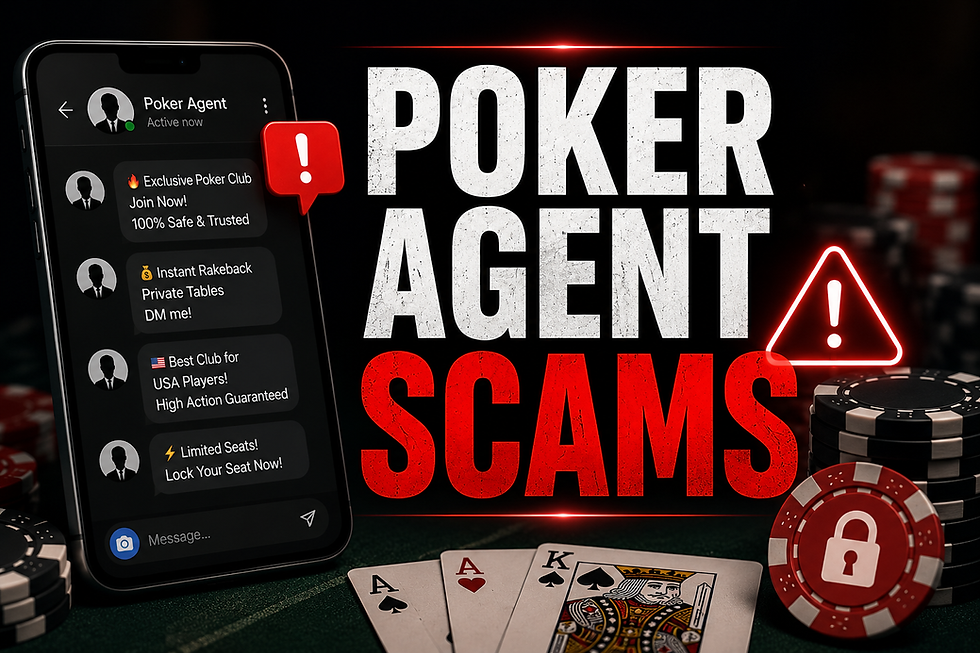
Instagram DMs. Telegram messages. WhatsApp groups. Random screenshots. Huge rakeback promises. Private club access. “Soft games bro.” Copy-paste Google Sheets lists with dozens of clubs.
Some poker agents are real and useful.
Some are lazy.
Some are dangerous.
And for players, the risk is not only choosing the wrong poker club. The real risk is trusting the wrong person with your money, your crypto payments and your poker balance.
In this guide, we will explain the most common poker agent scams, why Instagram poker spam is a problem, how the classic Google Sheets club list can mislead players, and why fake USDT payments are one of the most important risks to understand before you deposit.
📌 Table of Contents
❓ FAQ
🕵️ Why There Are So Many Poker Agents Today
Online poker is no longer just PokerStars, GGPoker or traditional public poker rooms.
Today, many players also use:
poker apps;
private clubs;
agent-based poker networks;
crypto poker sites;
Asian poker apps;
invite-only communities;
rakeback deals;
private liquidity pools.
This created space for agents, sub-agents, affiliates, club managers and brokers.
In theory, this is not bad.
A good poker agent can help a player find better games, understand rakeback, access private clubs, avoid bad ecosystems and solve payment issues.
The problem is that the market is now full of people who call themselves agents but do not really provide value.
They do not analyze the player.
They do not explain the network.
They do not understand the difference between a skin, an app, a club and a player pool.
They do not help after the deposit.
They simply send the same offer to everyone and hope someone joins.
That is not poker brokerage.
That is spam.
📩 The Instagram Poker Agent Problem
One of the biggest problems today is Instagram poker spam.
You follow a poker page, comment on a hand, post a story about poker, or join a few public groups.
Suddenly, random accounts start messaging you.
Usually the message looks the same:
“Best poker club available.”
“High rakeback.”
“Soft games.”
“Fast withdrawals.”
“VIP club.”
“Message me bro.”
Sometimes they send screenshots of big balances, huge wins, tables full of action or fake-looking testimonials.
But most of the time, they do not explain anything important.
They do not tell you who manages the club.
They do not explain how withdrawals work.
They do not explain the real traffic.
They do not explain the rake structure.
They do not explain what happens if there is a dispute.
They do not explain whether the games are actually good for your level.
They just want the deposit.
That is the problem.
A serious poker agent should not treat every player the same way.
A beginner playing NL25 does not need the same environment as a PLO500 grinder.
A recreational player looking for easy mobile games does not need the same app as a high-volume professional.
A player from Europe does not always need the same solution as a player from the United States, Latin America or Asia.
If someone sends the same offer to every player, they are not selecting the right game for you.
They are simply trying to place you somewhere.
Looking for a Safer Way to Choose Where to Play?
Random Instagram agents usually send the same offer to everyone.
At The Poker Broker, we do the opposite.
We help players compare poker sites, apps and private club options based on:
country;
stakes;
poker variant;
bankroll;
traffic;
rakeback;
payment method;
withdrawal reliability;
long-term suitability.
📊 The Google Sheets Club List Trap
Another very common sign of a low-quality poker agent is the famous Google Sheets club list.
You ask for information and they send you a file with 20, 30 or 50 clubs.
Usually it includes things like:
app name;
club name;
stakes;
rakeback percentage;
traffic notes;
“soft”;
“good action”;
“USA players”;
“PLO available”;
“fast cashout”.
At first, this can look professional.
It feels like you are receiving many options.
But a long Google Sheets list does not mean safety.
Sometimes it only means the agent is throwing the same offer at every player and hoping someone deposits.
The real questions are not written in the Google Sheets file.
Who is behind the club?
How long has the club been active?
Who is responsible for withdrawals?
Is the club stable?
Are there real players or mostly other agents and sub-agents?
Is the rakeback actually paid?
Are the games suitable for your level?
Is there a history of delayed payments?
What happens if the club closes?
What happens if the agent disappears?
What happens if there is a dispute with another player?
What happens if a withdrawal is blocked or delayed?
These are the questions that matter.
A player does not need a list of 50 random clubs.
A player needs to know which clubs to trust, which ones to avoid, and which poker environment actually fits their profile.
That is the difference between a spammer and a broker.

We Do Not Send the Same Google Sheet to Every Player
A copy-paste Google Sheets list is not real poker guidance.
At The Poker Broker, the goal is not to show you the longest club list.
The goal is to help you understand which option actually makes sense for you.
Some players need crypto poker.
Some players need private club access.
Some players need high rakeback.
Some players need mobile apps.
Some players need safer withdrawal structures.
Some players should simply avoid certain games, clubs or agents completely.
The best poker deal is not the one with the biggest number on a spreadsheet. It is the one that fits your real situation.
🚨 The Most Common Poker Agent Scams
Not every bad agent is a scammer.
Some are simply inexperienced, disorganized or too focused on commission.
But players should understand the most common scam patterns before sending money.
Fake Rakeback Deals
This is one of the most common traps.
The agent promises a huge rakeback percentage to attract the player.
But then the conditions are unclear.
Maybe the rakeback is not paid weekly.
Maybe it only applies after a certain volume.
Maybe some games are excluded.
Maybe the agent changes the terms after the player deposits.
Maybe the advertised percentage is technically true but not realistic for that player.
A high rakeback number means nothing if the deal is not clear.
Agent Disappears After Deposit
This is the classic nightmare.
Before the deposit, the agent replies instantly.
After the deposit, everything slows down.
Withdrawals take longer.
Questions are ignored.
Support becomes vague.
The player is told to “wait”.
Then the agent disappears.
This is why you should never judge an agent only by how friendly they are before you send money.
The real test is what happens after the deposit.
Fake Club Traffic
Some agents advertise clubs as active, soft and full of action.
Then you join and find almost no tables.
Or the traffic exists only at stakes you do not play.
Or the games are not as soft as promised.
Or the good tables shown in screenshots were taken at a specific hour and do not represent normal traffic.
Before depositing serious money, always ask about real traffic by stake, variant and time zone.
Fake VIP Access
Many players are attracted by the words “private club” or “VIP club”.
But private does not automatically mean good.
A private club can be great.
It can also be empty, high-rake, unstable or full of problems.
“VIP” is often just marketing.
The important questions are:
Who plays there?
What games run daily?
How is the club managed?
How are payments handled?
Is the player pool healthy?
Are withdrawals reliable?
If the agent cannot answer these questions, the word “VIP” means nothing.
Pushing Players Into Bad Games
Some agents do not recommend what is best for the player.
They recommend what pays them the most.
This is a serious conflict of interest.
A player may be pushed into a club with high rake, bad games, poor software, unstable withdrawals or unsuitable stakes simply because the agent earns more commission there.
A serious poker broker should sometimes say:
“This room is not right for you.”
“This game is too high for your bankroll.”
“This club has good traffic, but not for your variant.”
“This deal looks attractive, but the payment process is not ideal.”
Honest filtering is more valuable than a long list of options.
Fake Support Accounts
Another risk is impersonation.
Scammers can create fake Telegram, Instagram or WhatsApp accounts pretending to be an agent, broker, club owner or support representative.
They may use a similar username, same profile photo or almost identical branding.
Then they ask for a payment, wallet address confirmation or account information.
Before sending money, always verify that you are speaking with the real contact.
Do not trust a new account just because it uses the same logo.
Seed Phrase and Wallet Access Scams
No real poker agent, broker, poker room or crypto support should ever ask for your seed phrase.
Never share your seed phrase.
Never share private keys.
Never give remote wallet access.
Never connect your wallet to a suspicious link sent by a random agent.
If someone asks for your seed phrase, it is not support.
It is a scam.
🪙 Fake USDT and Crypto Payment Scams
Crypto payments are common in online poker.
They can be fast, practical and useful for international players.
But they also create new risks.
One of the most important risks is fake USDT.
Many players think that if they see “USDT” in a wallet or transaction screenshot, the payment must be real.
That is not enough.
Scammers can create tokens that imitate well-known assets like Tether USDT. The FBI has warned that criminals can create impersonation tokens and send them from addresses that look similar to legitimate wallet addresses in what is known as an address poisoning attack.
This matters a lot in poker because many transactions happen between players, agents and clubs through Telegram or private messages.
A fake crypto payment can be used to trick someone into releasing chips, balance or credit before real funds arrive.

“USDT” Is Not Enough
When someone sends you USDT, you need to verify more than the name.
You should check:
the correct blockchain;
the correct contract address;
the transaction hash;
the blockchain explorer;
whether the token is verified;
whether the wallet balance actually increased;
whether the payment is confirmed;
whether the token is the official asset, not a fake copy.
A fake token can look convincing at first glance.
It may use the same name.
It may use the same symbol.
It may appear in a wallet interface.
It may even have a transaction hash.
But that does not mean it is real USDT.
Official USDT Contract Examples
For example, Tether lists official supported protocols and contract information on its website.
Two commonly used USDT examples are:
USDT ERC20 on Ethereum: 0xdac17f958d2ee523a2206206994597c13d831ec7
USDT TRC20 on Tron: TR7NHqjeKQxGTCi8q8ZY4pL8otSzgjLj6t
Always verify the current official information from Tether’s own supported protocols page before making important payments, because supported networks and details can change over time.
Address Poisoning
Address poisoning is another dangerous scam.
A scammer sends a small transaction or fake token from a wallet address that looks similar to one you have used before.
Later, when you copy an address from your transaction history, you may accidentally copy the scammer’s lookalike address instead of the real one.
This can be very costly.
Many wallet addresses are long, and people often check only the first and last characters.
That is exactly what scammers exploit.
For poker players and agents, this means one simple rule:
Never copy a wallet address blindly from transaction history.
Always verify the full address using a trusted source.
Fake Payment Screenshots
This is very common in private poker environments.
Someone sends you a screenshot and says:
“Payment sent.”
“USDT confirmed.”
“Check wallet.”
“Please credit my poker balance now.”
Do not rely on screenshots.
Screenshots can be edited.
A transaction can be fake.
A token can be fake.
A hash can be misleading if it points to the wrong token contract.
A payment can be on the wrong network.
Never release poker chips, balance or credit based only on a screenshot.
Always verify the transaction on the correct blockchain explorer.
Wrong Network Payments
Another common issue is sending funds on the wrong network.
For example, a player may think they are sending USDT correctly, but they send it on a network the receiver does not support.
This can create delays, confusion or permanent loss depending on the wallet and platform.
Before sending funds, both sides should confirm:
coin;
network;
wallet address;
minimum amount;
expected confirmation time;
who is responsible if the wrong network is used.
Crypto is useful, but it must be handled carefully.
Need Help With Crypto Poker Payments?
Crypto can be very useful for online poker, but it must be handled carefully.
If you are unsure about:
which network to use;
whether a USDT payment is real;
how to verify a transaction;
how a poker site or club handles deposits;
whether an agent’s payment instructions look suspicious;
do not rush the deposit.
The Poker Broker can help you understand the payment process before you send funds.
We do not ask for your seed phrase.
We do not need wallet access.
We do not ask you to connect your wallet to suspicious links.
We simply help you avoid basic payment mistakes before they become expensive.
⚠️ Red Flags Before You Deposit
Before sending money to any poker agent, pay attention to red flags.
One red flag alone does not always prove a scam.
But when several appear together, you should be careful.
The Agent Contacts You Cold on Instagram
Cold DMs are not automatically scams.
But many bad agents use Instagram spam as their main strategy.
If the account has no clear identity, no real brand, no track record and no serious explanation, be careful.
The Agent Pushes You to Deposit Immediately
Pressure is a bad sign.
A serious agent should answer questions before asking for money.
If everything is urgent, limited, secret or “only today”, slow down.
The Agent Only Sends Screenshots
Screenshots are not due diligence.
A screenshot of a table, balance, rakeback payment or withdrawal does not prove the environment is safe.
Ask real questions.
The Agent Cannot Explain the Network
A serious agent should understand the difference between:
poker site;
poker app;
club;
union;
skin;
network;
player pool;
rakeback;
agent deal.
If the agent cannot explain where you are actually playing, that is a problem.
The Agent Avoids Withdrawal Questions
Deposits are easy.
Withdrawals are the real test.
Before depositing, ask:
How do withdrawals work?
How long do they usually take?
Are there limits?
Who approves them?
What happens if there is a delay?
Can I test a small withdrawal first?
If the answers are vague, be careful.
The Agent Promises Unrealistic Rakeback
High rakeback can be real in some environments.
But if the number sounds too good and the terms are unclear, it may be a trap.
Ask how it is calculated.
Ask when it is paid.
Ask if there are excluded games.
Ask if it depends on volume.
Ask if the deal is stable.
The Agent Changes Wallet Addresses Often
Wallet address changes can happen for legitimate reasons.
But frequent or unexplained changes are risky.
Always verify the payment address directly with the trusted contact.
Never use an address sent by a new or suspicious account.
The Agent Uses “Trust Me” Instead of Clear Answers
“Trust me bro” is not a business model.
If the agent cannot explain the offer clearly, the payment process clearly and the risks clearly, do not send serious money.
🔍 How to Verify a Poker Agent Before Sending Money
You can never remove every risk from online poker.
But you can reduce risk before depositing.
Start Small
Do not send a large deposit immediately.
Start with a small amount.
Test the account.
Test the games.
Test the communication.
Test the withdrawal process.
A small test can reveal a lot.
Test an Early Withdrawal
Many players only test withdrawals after they have built a large balance.
That is a mistake.
A serious environment should be able to process a small withdrawal early.
This does not guarantee future safety, but it is better than discovering problems too late.

Ask Specific Questions
Do not ask only:
“Is this club good?”
Ask:
What stakes run daily?
What variants run daily?
What time zones are best?
How is rakeback paid?
Who handles withdrawals?
What is the average withdrawal time?
Are there any limits?
What happens if there is a dispute?
Is this good for my exact stakes and game type?
Specific questions expose weak agents quickly.
Verify Crypto Payments Properly
For crypto transactions:
check the correct network;
check the full wallet address;
check the official token contract;
check the transaction on the explorer;
never rely only on screenshots;
never copy wallet addresses from random transaction history;
never share seed phrases or private keys.
Look for Real Support
A serious agent should not disappear when there is a problem.
Support matters after the deposit, not only before.
If the agent is extremely responsive when asking for money but slow when answering risk questions, that tells you something.
🤝 What a Serious Poker Broker Should Actually Do
A real poker broker is not someone who sends the same Google Sheets file to every player.
A real broker helps you understand where your money, volume and time are actually safer and more valuable.
A serious poker broker should:
understand your country;
understand your stakes;
understand your main poker variant;
understand your bankroll;
understand your volume;
explain the difference between sites, apps, clubs and networks;
explain rakeback and bonus terms clearly;
help with deposits and withdrawals;
avoid pushing you into unsuitable games;
warn you when a deal looks risky;
help you compare multiple options;
provide support after signup.
The best deal is not always the highest advertised rakeback.
The best deal is the one that fits your player profile, has reliable payments, offers real traffic and gives you support when something goes wrong.
That is why The Poker Broker exists.
We do not believe players need another random Instagram DM.
They need a serious filter.
They need someone who understands the market, knows the difference between real value and empty promises, and can help them avoid bad poker environments before they deposit.
How The Poker Broker Helps Players Avoid Bad Deals
The Poker Broker is built for players who are tired of random poker agents, unclear rakeback promises and copy-paste club lists.
We help you choose where to play based on real factors, not spam.
Depending on your profile, we can help you evaluate:
QQPK for players looking for Asian app-style action and strong VIP systems;
KKPoker for mobile poker app traffic;
CoinPoker for crypto poker players who want direct blockchain-friendly payments;
ClubGG for private club-style games and community-based poker action;
other poker sites, apps and networks depending on your country, stakes and goals.
The right option depends on who you are as a player.
A PLO grinder does not need the same environment as a recreational NLH player.
A USA player does not always need the same solution as a European player.
A low-stakes mobile player does not need the same deal as a high-volume professional.
That is why we do not believe in one-size-fits-all poker offers.
✅ Final Thoughts
There are more poker agents than ever.
But that does not mean there are more good poker opportunities.
Many players are surrounded by Instagram spam, copy-paste club lists, fake screenshots, unrealistic rakeback promises and crypto payment risks.
The goal is not to avoid every agent.
The goal is to avoid bad agents.
A serious poker agent or broker should help you choose better, play safer and understand the risks before your money is involved.
Before joining a new poker club, app or private deal, ask better questions.
Verify payments.
Test withdrawals.
Be careful with fake USDT.
Do not trust screenshots.
Do not trust random DMs.
Do not trust a long Google Sheets list just because it looks professional.
In online poker, the wrong agent can cost more than a bad session.
❓ FAQ
Are poker agents always scams?
No.
Some poker agents are legitimate and useful.
A good agent can help players find better games, understand rakeback, access private clubs and solve payment issues.
The problem is that the market also has many spammers, inexperienced sub-agents and unsafe operators.
The key is not to avoid every agent.
The key is to verify who you are dealing with before sending money.
Is Instagram poker spam dangerous?
It can be.
A random Instagram DM is not automatically a scam, but many bad poker agents use Instagram spam to contact players without context.
Be careful if the account is anonymous, pushes you to deposit quickly, sends only screenshots, cannot explain the club or avoids withdrawal questions.
Is a high rakeback deal always better?
No.
High rakeback means nothing if the games are bad, withdrawals are slow, terms are unclear or the agent is unreliable.
Sometimes a lower but more stable deal is better than a huge number with no transparency.
Always ask how rakeback is calculated, when it is paid and what conditions apply.
What is the Google Sheets club list trap?
The Google Sheets club list trap is when an agent sends a long spreadsheet full of poker clubs, apps, stakes and rakeback numbers to make the offer look professional.
But a long list does not prove safety.
The important questions are who manages the club, how withdrawals work, whether the traffic is real, whether the games fit your level and what happens if there is a problem.
Can fake USDT look real in a wallet?
Yes.
Fake tokens can imitate the name or symbol of USDT.
A player should verify the correct blockchain, contract address, transaction hash and explorer before accepting a payment as real.
Never release poker balance or credit based only on a screenshot.
What is address poisoning?
Address poisoning is a crypto scam where a scammer sends transactions or fake tokens from an address that looks similar to one you have used before.
The goal is to make you copy the wrong address from your transaction history and send funds to the scammer.
Always verify the full wallet address before sending crypto.
Should I trust crypto payment screenshots?
No.
Screenshots can be edited or misleading.
Always verify the transaction on the correct blockchain explorer.
Check the token contract, network, wallet address and confirmations before treating a crypto payment as received.
What is the safest way to test a new poker agent?
Start small.
Do not deposit a large amount immediately.
Ask specific questions, test the games, verify crypto payments properly and request a small withdrawal early.
A serious agent should not be afraid of basic due diligence.
Can The Poker Broker help me avoid unsafe poker clubs and agents?
Yes.
The Poker Broker helps players compare poker sites, apps and private club options based on traffic, rakeback, game quality, payment process, reliability and player profile.
Instead of trusting random Instagram spam or copy-paste Google Sheets lists, you can contact us on Telegram before choosing where to play.