











Bum Hunting in Online Poker: When Game Selection Becomes Predatory

Updated: Oct 16

Every serious poker player understands one simple truth:
Poker is not only about playing your cards well. It is also about choosing the right games.
A great player in a terrible game can make less money than an average player in a soft one. That is why game selection has always been part of winning poker.
But in modern online poker, there is a line that many players do not understand until it is too late.
That line is called bum hunting.
For regulars, bum hunting can look like smart table selection.
For recreational players, it can feel like being hunted.
For poker sites, it can become a direct threat to the health of the entire ecosystem.
And this is exactly why some poker rooms now treat bum hunting as a serious violation, not just as normal poker strategy.
Table of Contents
❓ FAQ
🧠 What Is Bum Hunting in Poker?
Bum hunting is the practice of deliberately looking for weak or inexperienced players while avoiding stronger opponents.
In simple terms, a bum hunter does not just look for a good game.
A bum hunter looks for a specific type of opponent, usually a recreational player, and often refuses to play unless that player is present.
Examples of bum hunting can include:
sitting only when a known weak player joins the table;
sitting out when the weak player leaves;
refusing to play hands against regulars;
following a recreational player from table to table;
opening tables only to trap weaker players;
avoiding action against anyone considered competent.
This is where the debate begins.
Because every poker player wants to find good games.
But not every form of game selection is treated the same way by poker sites.
🎯 Game Selection vs Bum Hunting
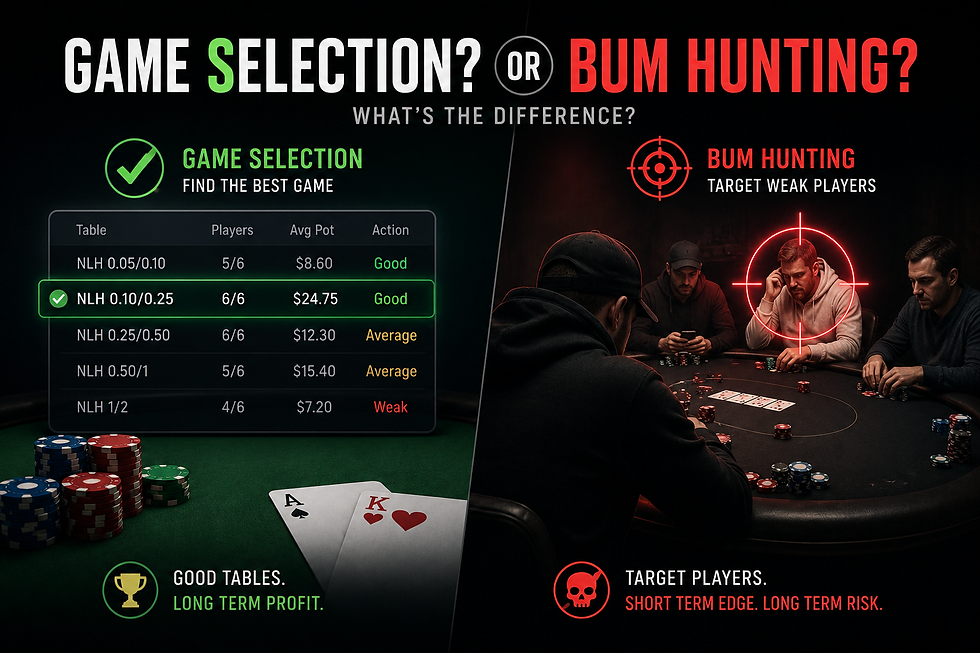
Game selection is normal.
Bum hunting is more controversial.
A professional poker player choosing a softer poker room, a better time zone, a weaker stake level or a format with more recreational traffic is simply making a smart business decision.
That is part of poker.
But there is a difference between selecting a good environment and targeting individual players in a way that damages the game.
Normal game selection means choosing good conditions.
Bum hunting means targeting specific weak players while refusing to participate in the wider ecosystem.
For example, choosing to play PLO because the field is softer than No Limit Hold’em is game selection.
Choosing to play on a poker app with more recreational traffic is game selection.
Choosing a site with better rakeback and softer games is game selection.
But sitting at a table only because one specific recreational player is there, then instantly leaving when that player busts, can be seen as bum hunting.
From the regular’s perspective, this may feel logical.
From the poker room’s perspective, it can be toxic.
🐟 Why Recreational Players Matter
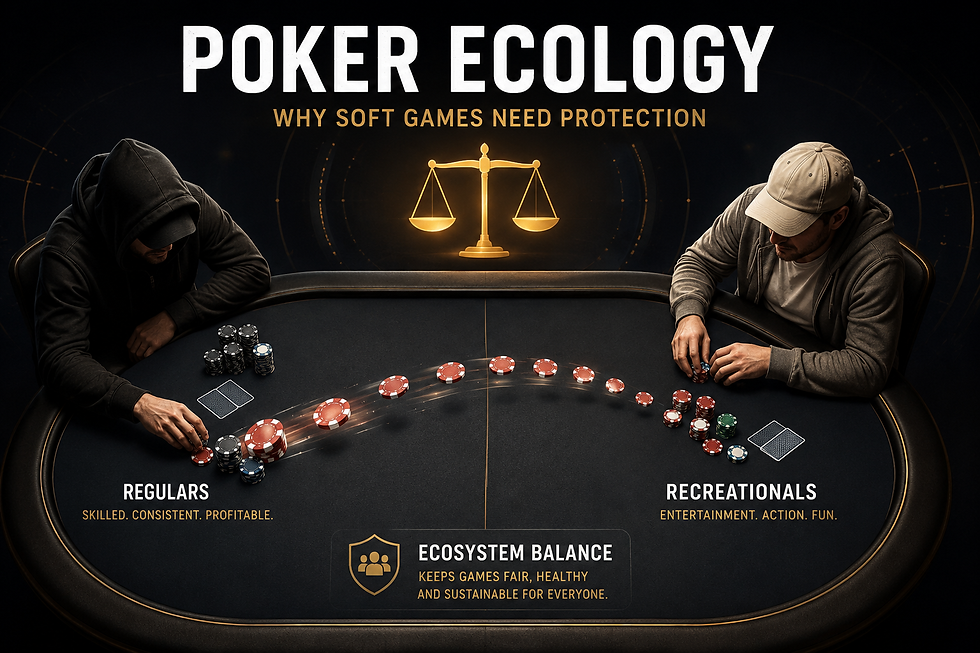
Online poker does not survive because of regulars.
It survives because of recreational players.
Regulars create volume.
Recreational players create liquidity.
Without recreational players, poker becomes a closed economy where strong players pass money back and forth while rake slowly drains the pool.
That is not sustainable.
A healthy poker ecosystem needs:
new deposits;
casual players;
losing players who still enjoy the game;
fair table distribution;
enough action for both professionals and amateurs;
a reason for recreational players to come back.
This is the part many winning players ignore.
If a recreational player deposits, sits at a table, gets instantly targeted by five regulars, loses quickly and feels like the entire table was waiting for him, that player may never return.
The regulars may win today.
But the ecosystem loses tomorrow.
That is why poker rooms care so much about this topic.
They are not only protecting bad players out of kindness.
They are protecting the economy of the game.
⚠️ Why Poker Sites Hate Bum Hunting
Poker sites hate bum hunting because it creates a terrible experience for the exact players they need most.
A new or casual player wants to feel like they are playing poker.
They do not want to feel like bait.
If every strong regular instantly identifies them, sits with them, isolates them and leaves as soon as they lose, the game becomes predatory.
This creates several problems for the room.
First, recreational players lose money too fast.
Second, games become less fun.
Third, tables become unstable.
Fourth, regulars stop giving action to each other.
Fifth, the poker room becomes known as a place where weak players get destroyed immediately.
That is bad for long-term liquidity.
A poker room does not want a lobby full of strong regulars waiting for one weak player to sit down.
It wants games running naturally.
This is why modern poker sites have introduced tools and policies such as:
anonymous tables;
seat randomization;
table caps;
fast-fold pools;
real-name policies at high stakes;
anti-bum-hunting rules;
restrictions on seating scripts;
limits on HUDs and third-party tools;
ecology-based reward systems.
These rules are not always popular with professionals.
But from the room’s perspective, they are part of keeping the games alive.
♟️ The GGPoker Case: When Ecology Became Policy

GGPoker is one of the most important examples in the modern bum hunting debate.
When the GGNetwork started growing aggressively, many regulars remember the games as extremely soft compared to traditional European and dot-com poker rooms.
There were huge recreational pools, especially in certain formats and time zones.
Some tables had players making massive preflop mistakes, random all-ins, loose calls and decisions that created enormous short-term winrates for experienced players.
For serious regulars, this looked like a dream.
But for the network, it also created a problem.
If too many professionals only entered games when weak recreational players were present, won quickly, and left immediately after those players lost their stacks, the ecosystem could become predatory.
This created tension between two completely different views of poker.
From the regular’s point of view:
“I am just selecting good games.”
From the room’s point of view:
“You are extracting from recreational players without contributing to the games.”
That tension became public during several controversies involving banned or restricted accounts.
Some winning regulars felt they were being punished for winning too much.
GGPoker publicly denied that interpretation and argued that enforcement was based on violations of its Terms of Service, including cheating, collusion, bum hunting and predatory behavior.
This distinction matters.
A poker site banning winning players simply because they win would be very different from a poker site banning players for behavior it considers harmful to the ecosystem.
The problem is that, in practice, the line can feel blurry.
A regular may think he is making smart professional decisions.
The room may see the same behavior as systematic targeting of weaker users.
That is why bum hunting is one of the most controversial subjects in online poker.
👉 Read our [Why Some Poker Rooms Ban Winning Players (And Why It’s More Complicated Than You Think)].
💰 Why Winning Regulars Felt Targeted
To understand the controversy, you also need to understand the regular’s side.
Professional poker is not easy.
Rake is high.
Edges are smaller.
Games are tougher than they used to be.
Many formats are filled with solvers, training groups, HUDs, database analysis and strong players who know what they are doing.
So when a professional finds a soft table, he naturally wants to play it.
That is not greed.
That is poker.
A winning player may ask:
“Why should I be forced to play bad games against other regulars when my entire job is to find profitable spots?”
This is a fair question.
Poker has always rewarded skill, discipline and game selection.
If a recreational player chooses to sit in a high-stakes game, many professionals believe that player is accepting the risk.
From this perspective, anti-bum-hunting rules can feel like the poker room is protecting losing players too much and punishing the people who actually study the game.
This is why many regulars become angry when rooms use words like “predatory behavior”.
They do not see themselves as predators.
They see themselves as professionals.
And in many cases, the difference is not obvious.
Why Poker Rooms See It Differently
Poker rooms do not look at one hand, one table or one winning session.
They look at the entire ecosystem.
They see how money moves.
They see who starts games.
They see who only joins when a certain player appears.
They see who sits out when the recreational player leaves.
They see who avoids other regulars.
They see who follows weak players across tables.
They see patterns that individual players may not even realize are obvious.
From the room’s perspective, a player may be profitable not because he is simply better at poker, but because he is only playing in ultra-selected spots and refusing to give action back to the pool.
That is the core of the bum hunting issue.
A healthy poker economy needs circulation.
If everyone only waits for the weakest player, games stop functioning naturally.
The strongest regulars become predators.
The weaker regulars stop playing.
The recreational players leave.
The lobby dies.
This is why poker sites increasingly care about ecology, not just security.
Security is about stopping cheating.
Ecology is about keeping the game sustainable.
The Olive Branch Era

An interesting development came later with GGPoker’s Olive Branch Initiative.
This initiative gave some previously banned players a path to request account review or possible reinstatement.
That does not mean every ban was wrong.
It does not mean the room abandoned its security policy.
But it does show that modern poker rooms are trying to balance enforcement with second chances.
This is important because poker ecology is not simple.
Some players clearly break rules.
Some players operate in grey areas.
Some players may have behaved badly years ago but later changed.
Some players may feel they were punished too harshly.
A mature poker ecosystem needs rules.
But it also needs clarity.
That is the real lesson.
The issue is not only whether bum hunting is allowed or banned.
The issue is whether players understand where the line is before they cross it.
🌍 Bum Hunting and Poker Ecology
Poker ecology is one of the most misunderstood concepts in online poker.
Most casual players think poker sites only care about rake.
Many regulars think poker sites should simply let the best players win.
But the reality is more complicated.
A poker site wants games that last.
That means the room wants recreational players to lose slowly enough that they still enjoy the experience.
It wants professionals to generate volume, but not destroy the recreational pool too quickly.
It wants winning players, but not players who make the games feel predatory.
It wants liquidity, but not a lobby where everyone is waiting for one weak player.
This is why ecology-based decisions can look strange from the outside.
A room may reduce rewards for certain high-volume winners.
A room may ban seating scripts.
A room may hide player names.
A room may restrict table selection.
A room may punish players who constantly sit out against strong opponents.
These decisions are not always popular.
But they are all connected to the same question:
How do you keep poker beatable for good players without making it miserable for recreational players?
That is the central problem of modern online poker.
📱 Private Apps, Asian Poker Rooms and Table Selection

QQPK, one of the leading asian poker apps.
The bum hunting debate becomes even more interesting when you look at private apps and Asian poker ecosystems.
On public poker sites, the room controls the lobby.
On private club apps, the ecosystem is often controlled by clubs, agents, unions and private communities.
This changes everything.
In some private environments, table selection is less about clicking the right lobby and more about joining the right network.
The quality of the games depends on:
who controls the club;
how players are invited;
how recreational traffic enters the pool;
whether the games are protected;
how agents manage liquidity;
whether regulars are allowed to overhunt weak lineups;
how withdrawals and trust are handled;
whether the ecosystem is built for long-term survival.
This is why serious players should not only ask:
“Where are the softest games?”
They should ask:
“Is this ecosystem sustainable?”
A game that is extremely soft today can disappear tomorrow if recreational players are destroyed too quickly.
A site with slightly tougher games but better liquidity, better rules and better long-term structure may be more profitable over time.
This is where having real poker guidance matters.
Most review sites only talk about bonuses.
They do not understand ecology.
They do not understand liquidity.
They do not understand how regulars, agents, clubs and recreational players interact.
But these are the things that actually decide whether a poker environment is profitable.
🇺🇸 Massiv Union: The Private Club Version of Poker Ecology

The bum hunting debate becomes even more interesting when we move from public poker rooms to private club-based ecosystems.
One of the clearest examples is Massiv Union on ClubGG.
Massiv Union publicly describes itself as a global network of recreational poker clubs offering a safe and engaging playing environment on ClubGG. That positioning is important, because it tells us something about how private poker ecosystems are built.
They are not always designed as open, neutral lobbies where every type of player is equally welcome.
Many private unions are built around recreational traffic, trusted clubs, agents, VIP players and long-term game protection.
This creates a very different environment from a traditional online poker room.
On a normal poker site, a winning regular usually expects to be allowed to win as long as he does not cheat, collude, use forbidden software or break the rules.
In a private poker union, the question can become broader:
Are you good for the ecosystem, or are you damaging the games?
That is where bum hunting, country restrictions and recreational player protection all connect.
Massiv Union is often described by public affiliate guides as a recreational-heavy ClubGG environment with strong North American traffic. This type of player pool can be extremely attractive for strong international regulars, especially if the games are softer than traditional online poker pools.
But soft games also need protection.
If too many strong grinders enter a private ecosystem only to target the weakest lineups, avoid tougher games and extract aggressively from recreational players, the operator may start treating that traffic as a problem.
This is not only about one player following one fish from table to table.
In private apps, it can become a larger ecosystem issue involving agents, clubs, country access, VIP protection, downlines, collusion risk, withdrawal trust and long-term sustainability.
Public guides about Massiv Union also mention banned or restricted countries, and one guide explains that players from certain banned countries are not allowed because those player pools have developed a reputation for cheating, scamming or winning at very high rates on other apps.
That sentence is revealing.
It shows how private unions can treat geography as part of game protection.
A country restriction is not always only about regulation.
Sometimes it is also about ecology.
Some regions are associated with strong online grinders, multi-tablers, VPN users, collusion groups or aggressive game selection. Whether that reputation is fair to every individual player is another question. But private poker ecosystems often make access decisions based on perceived risk to the games.
This is why some winning players feel private poker apps can be unfair.
A regular may think:
“I am not cheating. I am just better than the field.”
But the operator may see the same player differently if he is consistently winning from recreational-heavy tables, avoiding tougher lineups or creating pressure on VIP players.
That is the private club version of the bum hunting debate.
It is not only about whether a player is technically breaking poker rules.
It is about whether the ecosystem wants unlimited professional pressure or a protected recreational environment.
Massiv Union and similar private ecosystems show why players should never choose a poker club only because the games look soft.
Soft games can be profitable.
But soft games with strict access rules, country restrictions, subjective ecology controls or unclear dispute processes can also become risky for winning regulars.
Before playing in any private poker union, serious players should understand:
whether their country is accepted;
whether VPN use is forbidden;
whether winning regulars are welcome;
how the union handles suspicious traffic;
how disputes are resolved;
whether the agent or club is reliable;
how withdrawals are managed;
whether the ecosystem is built for long-term play or short-term extraction.
This is the real lesson.
The best poker environment is not simply the softest one.
The best poker environment is the one where you understand the rules before you risk your bankroll.

✅ Is Bum Hunting Always Unethical?
No.
This is where the discussion needs nuance.
Not all game selection is unethical.
In fact, game selection is one of the most important skills in poker.
A player who ignores table quality is not being noble.
He is probably losing money.
Choosing softer rooms, better formats, better times and better lineups is part of professional poker.
But there is a difference between finding good games and actively hunting specific weak players while refusing to play anyone else.
A simple way to think about it is this:
Game selection is choosing good conditions.
Bum hunting is targeting weak individuals.
If you play in a soft PLO6 pool because the average player is weaker, that is game selection.
If you follow one losing player from table to table and instantly leave when he leaves, that is much closer to bum hunting.
If you choose a poker room with better recreational traffic, that is game selection.
If you sit out every time a regular joins and only play hands against one specific amateur, that can become predatory.
The line is not always perfectly clear.
But the concept is simple:
Poker rooms want players to participate in the ecosystem, not just extract from its weakest members.
🧭 What Smart Players Should Learn
The lesson is not that winning is bad.
The lesson is not that regulars should stop looking for good games.
The lesson is that modern online poker is no longer only about technical skill.
It is about understanding the room.
Before choosing where to play, serious players should think about:
how soft the games are;
how stable the traffic is;
how the room treats winning players;
what the anti-bum-hunting policy says;
whether HUDs or seating scripts are allowed;
whether the rakeback system is transparent;
how withdrawals are handled;
whether the ecosystem is recreational-friendly;
whether the games are sustainable long term.
This is especially important for players moving between traditional poker sites, crypto poker rooms, Asian apps and private clubs.
The best site is not always the one with the biggest bonus.
It is not always the one with the softest table today.
The best site is the one where you can actually play, win, withdraw and continue finding good games without constantly fighting the ecosystem.
That is why poker site selection matters.
And that is why players should stop reading generic review sites written by people who have never played serious online poker.
A real poker decision is not just about promotions.
It is about liquidity, ecology, rules, risk and long-term profitability.

Need Help After a Ban or Choosing a Safer Poker Site?
If you have been banned, restricted, flagged, or you are simply looking for a safer place to play, do not choose your next poker site blindly.
Every poker room and private club has different rules, different risk tolerance, different withdrawal processes and different views on winning players, table selection, VPN use and ecosystem protection.
At The Poker Broker, we work directly with multiple poker rooms, clubs and agents, and we can help you understand your options before you risk more money.
We cannot guarantee that any banned account will be reopened.
But we can help you evaluate what happened, avoid the same mistake again, and find poker environments that better match your profile, country, playing style and bankroll.
The softest game is not always the safest game.
If you need help after an account issue, or you want guidance before choosing your next poker site or private poker club, contact us directly on Telegram.
If you want help choosing the right poker site, private app or poker ecosystem for your goals, contact The Poker Broker on Telegram.
Final Thoughts
Bum hunting sits at the center of one of online poker’s biggest conflicts.
Regulars want to maximize their edge.
Recreational players want to enjoy the game.
Poker rooms want to protect liquidity and keep their ecosystems alive.
Game selection will always be part of winning poker, but modern poker sites and private
clubs may treat some forms of table selection as predatory behavior.
That is why smart players need to think beyond bonuses, rakeback and soft games.
They need to understand the rules, the ecosystem and the risks before they play.
Because in today’s online poker world, the real edge is not only knowing how to win.
It is knowing where you can win safely.
❓ FAQ
What does bum hunting mean in poker?
Bum hunting means deliberately looking for weaker or less experienced players while avoiding stronger opponents. In online poker, this often involves sitting only when a recreational player is present, sitting out against regulars, or leaving as soon as the weak player leaves the table.
Is bum hunting the same as game selection?
No. Game selection means choosing profitable games, formats, stakes or poker rooms. Bum hunting is more specific and usually refers to targeting individual weak players while refusing to participate in normal games against the rest of the pool.
Why do poker sites ban bum hunting?
Poker sites ban or restrict bum hunting because it can damage the poker ecosystem. If recreational players feel targeted and lose too quickly, they may stop playing. This reduces liquidity and makes the games worse for everyone over time.
Did GGPoker ban players for winning?
GGPoker has publicly stated that it does not ban players simply for winning. The room has said enforcement actions are based on violations of its rules, including cheating, collusion, bum hunting or predatory behavior. However, some winning regulars have historically felt that anti-bum-hunting enforcement punished profitable players too aggressively.
Is bum hunting unethical?
It depends on the behavior. Choosing softer games is normal poker strategy. Following specific recreational players, refusing to play anyone else, and leaving immediately after weaker players bust can be considered predatory by many poker rooms.
Can professional players still use game selection?
Yes. Game selection is still an important part of poker. The key is understanding the rules of the room and avoiding behavior that looks like systematic targeting of weaker players.
Why is poker ecology important?
Poker ecology describes the health of the poker ecosystem. A good ecology has recreational players, regulars, liquidity, fair games and enough money circulating to keep games running. If the ecology becomes too predatory, recreational players leave and the games eventually die.
What should I check before choosing an online poker site?
You should look at traffic, game quality, rakeback, withdrawal reliability, rules on HUDs and bum hunting, player pool softness, liquidity and long-term sustainability. The best poker site is not always the one with the biggest bonus.
Can my poker account be flagged for bum hunting?
Yes. Some poker rooms monitor table selection patterns, sitting out behavior, repeated targeting of weaker players, refusal to give action to stronger players and other signs of predatory game selection.
Being flagged does not always mean a player has cheated.
But it may mean the poker room believes the player’s behavior is damaging the ecosystem.
What should I do if my poker account is banned or restricted?
If your account is banned, restricted or placed under review, the first step is to read the room’s message carefully and avoid sending emotional replies.
You should collect the relevant information, including account nickname, dates, emails, screenshots, withdrawal status and any explanation given by the room.
Some poker rooms may allow appeals or account reviews, but reinstatement is never guaranteed.
Can The Poker Broker help if I was banned from a poker site?
We cannot guarantee that any banned account will be reopened.
But we can help players understand what may have happened, evaluate possible next steps and avoid repeating the same mistakes when choosing a new poker site, poker app or private club.
Because we work with multiple poker rooms, clubs and agents, we can often help players find a safer and more suitable environment for their country, playing style and bankroll.
Are private poker clubs safer than public poker sites?
Not always.
Private poker clubs can offer softer games, better access to recreational traffic and attractive rakeback deals, but they can also have more subjective rules, country restrictions, agent risk and less transparent dispute processes.
Before joining any private club, players should understand who controls the club, how withdrawals work, which countries are accepted and whether winning regulars are welcome.
Can using a VPN get my poker funds confiscated?
Yes, in some poker ecosystems VPN use can lead to serious consequences, including account closure or fund confiscation, especially if the VPN is used to hide a banned country, restricted jurisdiction or multi-accounting activity.
Before playing on any poker site or private app, players should understand the rules on country access and VPN use.
Is the softest poker game always the best game?
No.
A soft game can be very profitable, but it can also be risky if the rules are unclear, withdrawals are unreliable, the club is poorly managed, or winning players are treated as an ecology problem.
The best poker environment is not simply the softest one.
It is the one where you can play, win, withdraw and understand the rules before risking your bankroll.