














Cash Game vs MTT: Which Format Is Better for Online Poker Players?

Updated: 4 days ago

Choosing between cash games and poker tournaments is one of the first big decisions every online poker player has to make.
Some players love the freedom of cash games.
Others prefer the excitement of tournaments, deep runs, final tables and big scores.
But the real question is not simply:
“Which one is more fun?”
The real question is:
Which format fits your bankroll, your schedule, your skill set and your long-term goals?
Cash games and tournaments may use the same poker rules, but they are completely different environments.
They have different variance.
They require different bankrolls.
They reward different skills.
And they often fit completely different types of players.
In this guide, we’ll break down the real differences between cash games and tournaments, explain which format is better for different players, and show you how to choose the right online poker site based on the way you actually want to play.
Table of Contents
❓ FAQ
💰 Cash Games vs Tournaments: The Basic Difference
In a cash game, every chip has real money value.
If you sit at a $0.50/$1 table with $100, those chips represent $100.
You can sit down, play a few hands, double up, leave, reload, change table or stop whenever you want.
Cash games are flexible.
You control the session length.
You choose the table.
You can quit when the game becomes bad.
You can move to a softer table.
You can manage your exposure hand by hand.
That is why cash games are usually preferred by players who want a more stable grinding routine.
In a tournament, you pay a fixed buy-in and receive tournament chips.
Those chips do not have direct cash value.
You cannot simply cash them out whenever you want.
Your goal is survival and accumulation.
You need to outlast other players, reach the paid positions, and ideally make a deep run.
Tournament poker is built around changing stack sizes, rising blinds, antes, payout jumps, bubbles and final table pressure.
That makes tournaments exciting.
But it also makes them much more volatile.
You can play well and bust before the money.
You can make the right decision and still lose your tournament life.
You can go many events without a meaningful score, then suddenly make a deep run that changes your entire month.
That is the core difference:
Cash games reward consistency. Tournaments reward survival, timing and the ability to handle bigger swings.
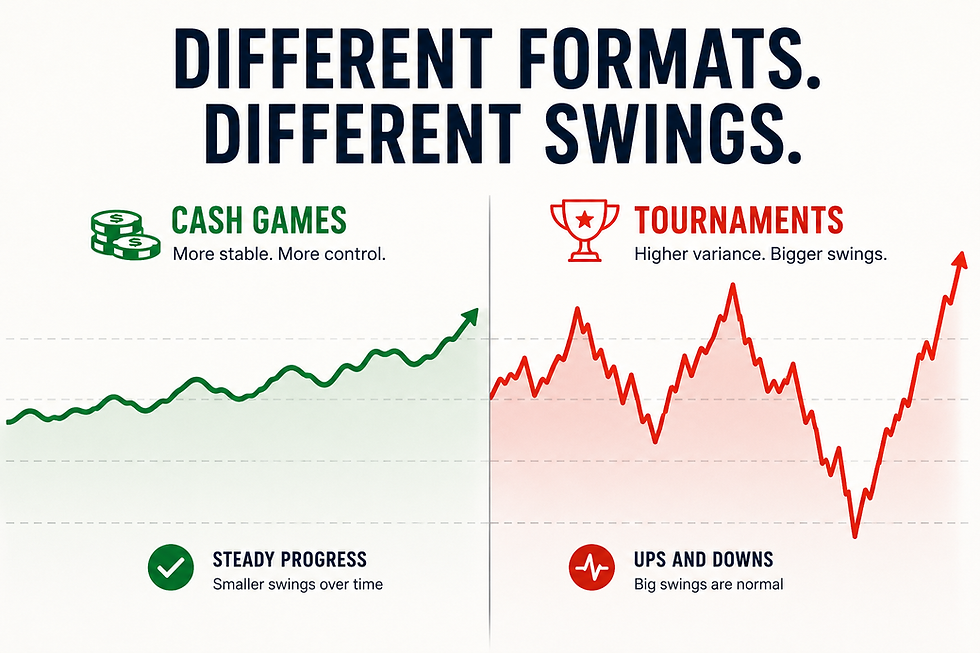
📊 Variance: Why Tournaments Swing Harder
Variance exists in every poker format.
Even strong winning cash game players can lose for days or weeks.
But tournament variance is usually much more brutal.
The reason is simple: in cash games, your results are spread across many hands, many pots and many reload opportunities.
If you lose a stack, you can rebuy.
If the table becomes bad, you can leave.
If you are tired, you can stop.
In tournaments, one lost all-in can end your entire session.
You may play three hours, make one standard shove, lose a flip and walk away with nothing.
That does not mean you played badly.
It means the tournament structure creates extreme short-term swings.
This is especially true in large-field MTTs.
The bigger the field, the more top-heavy the prize pool usually becomes.
Many players get paid small amounts.
A few players win most of the money.
That means your long-term profit often depends on rare deep runs.
This is why tournament players can experience long stretches of losing sessions even when they are profitable players.
Cash games can also be swingy, especially in formats like PLO, PLO5 or PLO6.
But in general, cash games offer more control over volume, table selection and session management.
If you want lower emotional pressure and more stable tracking, cash games are usually easier to manage.
If you enjoy big upside, competition, pressure spots and deep runs, tournaments may be more exciting.
🏦 Bankroll Management: How Much Do You Need?
Bankroll management is one of the biggest differences between cash games and tournaments.
A cash game player can usually work with a smaller buy-in cushion than a tournament player, because cash game variance is usually more controllable.
For example, a cash game grinder may decide to play a limit with 30, 40 or 50 buy-ins depending on the game type, winrate and personal risk tolerance.
A tournament player often needs a much larger bankroll.
Why?
Because even strong tournament players can go many events without a serious score.
Min-cashes do not cover the full reality of tournament variance.
The real profit often comes from final tables and top finishes.
That means you need enough buy-ins to survive the periods where you are playing well but not hitting deep runs.
This is where many beginners make a mistake.
They see a $22 tournament and think:
“I can afford that.”
But affordability is not bankroll management.
If your poker bankroll is $300, playing repeated $22 MTTs is extremely aggressive.
You are not simply buying one tournament.
You are exposing yourself to a format where losing many buy-ins in a row is completely normal.
Cash games are different.
If you have $300, you may be able to play much smaller cash games, control your table selection, stop when needed and build volume more gradually.
That does not make cash games automatically better.
But it does make them easier to structure for players who are still building discipline and confidence.
The bigger lesson is simple:
Cash game bankrolls protect your grind. Tournament bankrolls protect you from long periods without a deep run.

⏰ Time Commitment: Flexible Grind vs Long Sessions
Cash games are usually better for players who need flexibility.
You can play 30 minutes.
You can play two hours.
You can stop when the table becomes bad.
You can leave when you are tired.
You can take breaks more easily.
This is a huge advantage for players with work, family, business or limited free time.
Tournaments require a very different mindset.
Once you register, you are committing to the structure.
If you make a deep run, you may need to play for many hours.
You cannot simply leave because you are tired.
You cannot protect your profit by standing up.
You cannot decide that the table is bad and change table.
This is one reason why tournaments can be harder for casual players than they expect.
They look simple because the buy-in is fixed.
But the time commitment can be much bigger than expected.
A cash game player can choose quality over quantity.
A tournament player often has to accept long sessions, dead time, breaks, bubbles and late-night finishes.
So before choosing a format, ask yourself:
Do I want control over my schedule, or am I comfortable committing several hours to one session?
If you want flexibility, cash games are usually better.
If you enjoy long competitive sessions and chasing deep runs, tournaments may fit you better.
🎯 Skill Set: What Each Format Rewards
Cash games and tournaments reward different skills.
A strong cash game player needs to understand:
deep stack strategy
table selection
bet sizing
hand reading
rake impact
position
value betting
bluffing frequencies
emotional control
quitting bad games
Cash games are often about repeating small profitable decisions over and over again.
You do not need to win one huge event.
You need to make better decisions than the pool across thousands of hands.
Tournaments require many of the same poker fundamentals, but they add extra layers:
short stack play
push/fold decisions
ICM pressure
bubble strategy
final table adjustments
stack preservation
blind level awareness
payout laddering
changing aggression based on tournament phase
In cash games, chips are money.
In tournaments, chips are survival tools.
That changes everything.
A call that may be profitable in a cash game can be terrible in a tournament because of ICM.
A marginal spot that is standard in a tournament may be unnecessary in a soft cash game where you can wait for better opportunities.
This is why players should not assume that being good at one format automatically means being good at the other.
The games look similar.
But the decision-making environment is different.
💸 Rake and Fees: Where Players Lose EV
Rake matters in both formats.
In cash games, rake is usually taken from pots.
This means every pot you play can be affected by the site’s rake structure.
At low stakes, rake can be especially damaging because it represents a large percentage of the money in play.
This is why table selection, rakeback and game quality matter so much for cash players.
A soft table with high rake may still be playable.
A reg-heavy table with high rake can become almost impossible to beat.
In tournaments, the fee is usually charged upfront.
For example, a tournament may cost $10 + $1.
That means $10 goes to the prize pool and $1 is the fee.
The rake does not come out of every pot, but it still affects your long-term ROI.
If you play many tournaments with high fees and low edge, your expected profit becomes much harder to maintain.
This is one of the biggest mistakes online players make.
They compare poker sites only by bonus size or tournament guarantee.
But the real question is:
What is your actual net EV after rake, fees, rakeback, promotions and game quality?
A smaller bonus on a softer site can be worth more than a huge bonus on a tough site.
A moderate rakeback deal with good games can be better than a flashy promotion in a reg-heavy environment.
That is why serious players should always compare the full ecosystem, not just the headline offer.
📈 Profitability: Which Format Is Easier to Beat?
There is no universal answer.
Cash games can be more stable, but they can also become very tough if the pool is reg-heavy and the rake is high.
Tournaments can offer huge upside, but they require patience, volume and a stronger tolerance for variance.
For many players, cash games are easier to evaluate.
You can track your winrate.
You can compare tables.
You can see how different sites affect your results.
You can measure your hourly more clearly.
Tournaments are harder to evaluate because short-term results are extremely misleading.
A player can be losing for months and still be playing well.
Another player can hit one big score and think they are better than they really are.
That is why tournament results require a much larger sample size.
For beginners and part-time players, cash games often provide a cleaner learning path.
You can focus on one format, one stake and one table type.
You can build discipline.
You can understand how rake affects your winrate.
You can learn table selection.
For players who enjoy competition, pressure and big prizes, tournaments can be more motivating.
The right answer depends on your personality.
If you want control and consistency, cash games are usually better.
If you want excitement and upside, tournaments may be better.
If you want to become a complete poker player, understanding both formats is ideal.
📱 Online Poker Apps: Which Format Works Better on Mobile?
Mobile poker apps changed the way many players approach online poker.
On desktop sites, players often grind multiple tables, use tracking tools, study databases and play longer sessions.
On mobile apps, the environment is often more casual.
Sessions can be shorter.
Players may be less focused.
The traffic can be more recreational.
This can make mobile cash games very attractive, especially in Asian-style ecosystems where the action is faster and the games feel less like traditional desktop grinding.
Cash games often work very well on mobile because you can play shorter sessions and stop when needed.
Tournaments can also work on mobile, but long MTT sessions can be uncomfortable if you are playing only from your phone.
That does not mean mobile tournaments are bad.
It simply means that you should think about your setup.
If you are planning to play a long tournament session, desktop is usually more comfortable.
If you want quick access to cash games, mobile apps can be very efficient.
This is also why many players use different sites for different formats.
One account may be better for crypto tournaments.
Another may be better for Asian-style cash games.
Another may be better for mobile grinding.
The best players do not choose one site blindly.
They choose the right environment for the format they want to play.
♣️ Best Poker Rooms for Cash Games and Tournaments
The best poker room depends on the format you actually want to play.
A strong cash game site is not always the best tournament site.
And a great tournament room is not always the best place to grind cash games every day.
That is why players should not choose a poker room only because it is famous.
They should choose based on:
game type
traffic
rakeback
player pool
payment method
tournament schedule
cash game quality
long-term EV
For this reason, we usually separate the best options by format.

Best Options for Cash Games
If your main goal is to grind cash games, you should focus on rooms with good table availability, softer action, useful rewards and flexible access.
For cash game players, the two main rooms to compare are CoinPoker and QQPK.
CoinPoker

CoinPoker is one of the best options for players who want a crypto-friendly poker site with strong cash game value.
The main reason CoinPoker fits cash game players is its reward structure.
CoinPoker offers 15% daily rewards, plus CoinRewards features such as CoinRaces, Splash Pots, missions and bankroll boosts.
That makes it interesting for players who want to grind volume and get extra value back from their play.
CoinPoker can also be useful for players who want:
crypto deposits and withdrawals
international traffic
regular cash game action
transparent rewards
leaderboard value
a modern poker client
This makes CoinPoker a strong option for players who want to focus on cash games while still having access to tournaments when needed.
QQPK

QQPK is another strong cash game option, especially for players looking for Asian-style NLH cash game action.
This is important:
QQPK should be treated mainly as a cash game room, not as a PLO-heavy room.
The best angle for QQPK is No Limit Hold’em cash games, especially 6-max and 8-max action.
QQPK can be a good fit for players who want:
NLH cash games
Asian-style action
6-max and 8-max tables
mobile-friendly access
a different player pool from traditional poker sites
cash game focused grinding
For players who prefer cash games over long tournament sessions, QQPK is one of the most relevant rooms to compare.
Best Options for Tournaments
If your main goal is to play tournaments, the priorities change.
You need a strong MTT schedule.
You need guarantees.
You need satellites.
You need different buy-in levels.
You need regular series and enough traffic to find tournaments at the right time.
For tournament players, the two main rooms to compare are ACR Poker and GGPoker.
ACR Poker
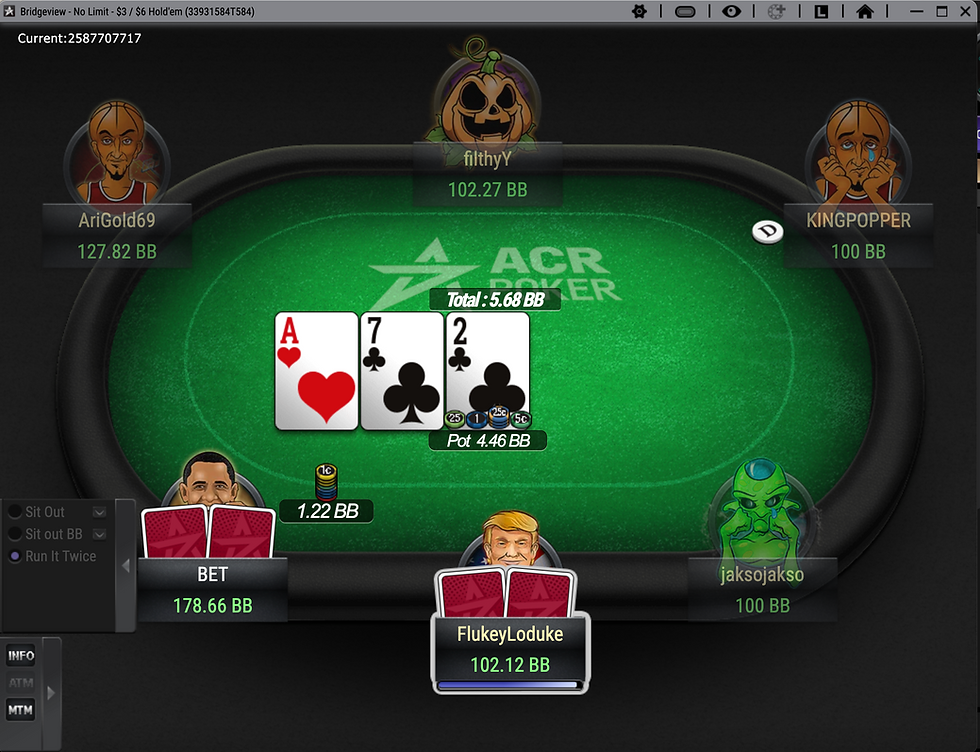
ACR Poker is one of the strongest options for tournament players, especially players looking for big online MTT series, satellites and major guaranteed events.
ACR is known for large tournament schedules and major events such as The Venom, one of its flagship tournament brands.
This makes ACR a better fit for players who prefer:
MTT grinding
big guarantees
satellite paths
large-field tournaments
crypto-friendly access
regular tournament series
ACR can also be useful for players who want tournament volume outside the most traditional regulated poker markets.
If your goal is to chase MTT scores rather than grind daily cash games, ACR belongs much more naturally in the tournament section.
GGPoker
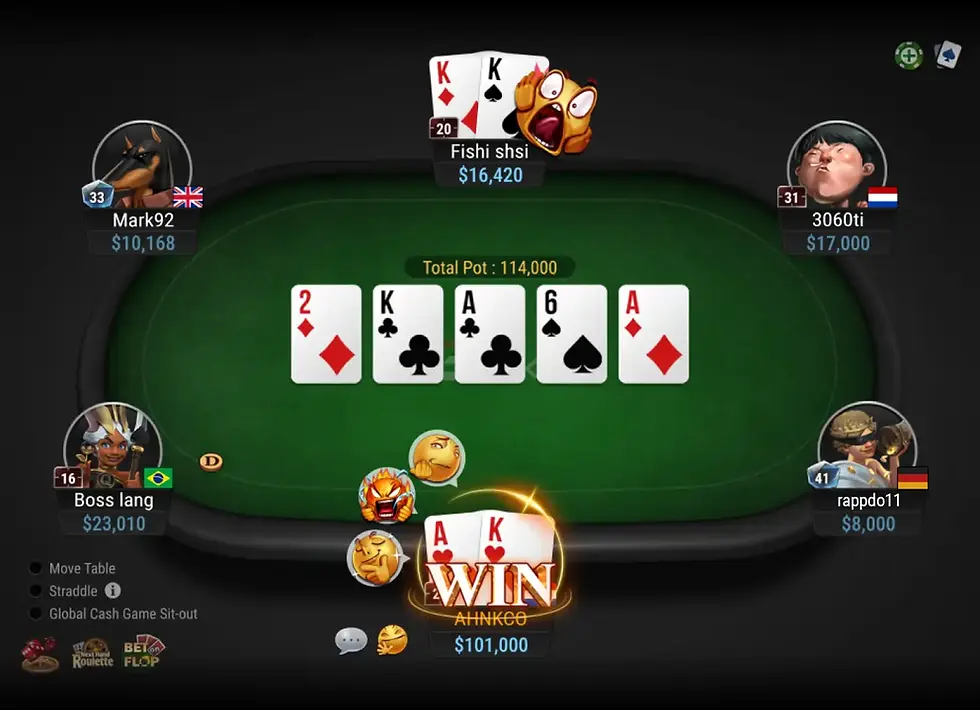
GGPoker is one of the strongest tournament platforms in online poker.
It has massive traffic, a large tournament ecosystem and major branded events connected to the WSOP universe.
For tournament players, GGPoker can be attractive because it offers:
huge MTT traffic
large guarantees
WSOP-related online events
GGMasters-style formats
satellites
many buy-in levels
strong international liquidity
GGPoker is usually a better recommendation for players who care about tournament volume, prize pools and major online series.
Choosing the Right Room by Format
Choose CoinPoker if you want crypto-friendly cash games, daily rewards and extra value from promotions.
Choose QQPK if you want Asian-style NLH cash game action, especially 6-max and 8-max tables.
Choose ACR Poker if you want large-field MTTs, satellites and major guaranteed tournament events.
Choose GGPoker if you want one of the biggest tournament ecosystems, huge traffic and WSOP-connected online events.
The key point is simple:
Do not choose a poker room in general. Choose the best poker room for the format you actually play.
A cash game player and a tournament player do not need the same site.
They need different traffic.
Different rewards.
Different structures.
Different schedules.
And often, completely different accounts.
Not sure which room fits your format?
✅ Final Thoughts
Cash games and tournaments are both part of online poker, but they are not the same business.
Cash games are usually better for players who want flexibility, consistency and clearer long-term tracking.
Tournaments are better for players who enjoy competition, pressure and the possibility of a big score.
Neither format is automatically better.
The right choice depends on your bankroll, schedule, personality and goals.
But one thing is always true:
The site you choose matters.
A good format on the wrong site can become a bad investment.
High rake, poor traffic, slow withdrawals, weak support or bad table quality can destroy your results even if you are technically a winning player.
At The Poker Broker, we help players compare poker rooms based on real factors:
game quality
traffic
rakeback
cashout speed
payment options
player pool
format availability
long-term value
Not sure whether you should focus on cash games or tournaments?
❓ Frequently Asked Questions
Are cash games better than MTT?
Cash games are usually better for players who want flexibility, lower variance and clearer tracking.
Tournaments are better for players who enjoy big prize potential, long sessions and competitive structures.
Are MTT more profitable than cash games?
They can be, but tournament profit is usually much more volatile.
A player may lose many events before making one deep run.
Cash game profit is often easier to measure over time.
Do tournaments have more variance than cash games?
Yes, tournaments usually have higher variance because one lost all-in can end your entire session, and most of the profit often comes from rare deep runs.
Are cash games better for beginners?
For many beginners, cash games are easier to learn because they allow shorter sessions, easier bankroll control and clearer feedback.
However, beginners can also enjoy small tournaments if they understand the variance.
How much bankroll do I need for cash games?
It depends on your stake, skill level, game type and risk tolerance.
Many players use a larger cushion for tougher or more volatile games.
How much bankroll do I need for tournaments?
Tournament players usually need a larger bankroll because MTT variance is high.
The bigger the field and the faster the structure, the more buy-ins you usually need.
Which format is better for mobile poker?
Cash games often work better on mobile because sessions are shorter and more flexible.
Tournaments can work too, but long MTT sessions are usually more comfortable on desktop.
Is rake more important in cash games or MTT?
Rake matters in both.
In cash games, it comes out of pots.
In tournaments, it is usually charged as an entry fee.
In both cases, rake affects your long-term profitability.
Can I play both cash games and tournaments?
Yes, but you should track them separately.
Cash games and tournaments require different bankrolls, strategies and mental approaches.
What is the best poker site for cash games?
What is the best poker site for tournaments?
For tournaments, ACR Poker and GGPoker are more natural options.
ACR Poker is strong for MTT schedules, satellites and major guaranteed events.
GGPoker is one of the biggest tournament ecosystems online, with huge traffic and major WSOP-connected events.
Should I choose a site based only on bonuses?
No.
Bonuses matter, but they are only one part of the equation.
You should also consider game quality, rake, rakeback, withdrawals, traffic and support.


Comments