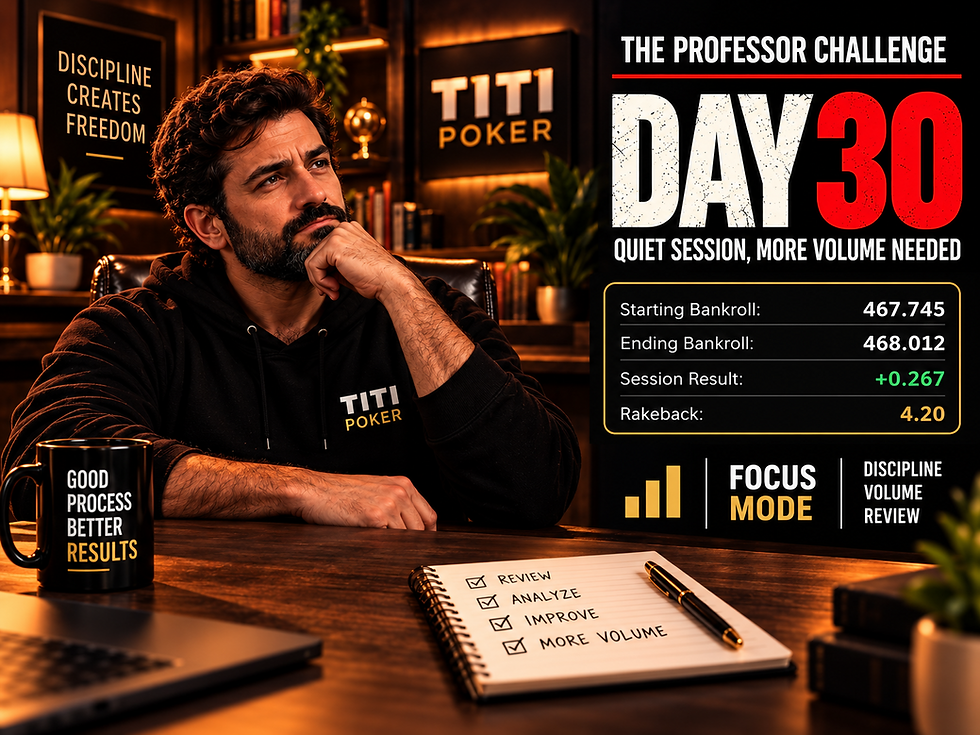











The Professor Challenge – Day 13: Patience Pays Off

Updated: Oct 16

Bankroll Progress
Starting Bankroll: 1,339.98 DC
Ending Bankroll: 1,345.51 DC
Session Result: +5.53 DC
Session Length: Approximately 2.5 hours
Challenge Status: Summer is over and the next priority is increasing volume.

📖 Table of Contents
🎯 A Longer Session at Last
Today I finally managed to put in a longer session on Red Dragon Poker: roughly two and a half hours. After the stop-start rhythm of the summer, simply getting a more meaningful block of hands in felt important.
The session itself was not spectacular. In fact, for long stretches it felt like the exact opposite. I kept finding premium hands, building pots preflop and then reaching flops where there was very little reason to continue.
That may not produce the kind of hand history that makes a great highlight reel, but it is exactly the kind of session that tests whether the adjustments I have been making are becoming automatic.
🧱 Premium Hands, Missed Boards, and Discipline
For most of the session, the pattern was repetitive: I would three-bet a strong starting hand, get called, and then face a board where I had completely missed. Other times I connected with the flop, only to see later streets complete the obvious draw and force me to give up.
When this happens once, folding is easy. When it happens repeatedly for two and a half hours, patience becomes part of the technical decision. The temptation is to convince yourself that the next premium hand has to be the one that finally gets paid.
That is exactly when a player can start leaking money. A strong preflop hand does not create an obligation to win the pot. If the board, the action and the opponent all tell me that continuing is bad, the correct decision is still to fold.
Red Dragon has already taught me that the field can be extremely aggressive and willing to gamble. Day 13 was a reminder that exploiting that tendency does not mean fighting for every pot. Sometimes the edge comes from refusing to overplay a hand simply because it started as a premium.
💰 Somehow, Still in Profit
The strange part is that, despite how frustrating the session felt, I still managed to finish slightly in profit before rakeback.
It was not a meaningful win in absolute terms, but psychologically I think it matters. A session can feel bad without actually being played badly, and a day full of folds does not automatically have to become a losing day.
That is one of the biggest differences between judging poker by individual pots and judging it over a large sample. Today felt like a grind because the memorable moments were mostly three-bets followed by folds. The bankroll, however, tells a calmer story: survive the bad run of boards, avoid forcing action, and keep taking the profitable spots that do appear.
If you missed the previous updates, you can read Day 12, Day 11, and our Red Dragon Poker 2026 overview for more context on the games and the adjustments behind this challenge.
⏳ Volume and Patience Are the Real Test
Today confirmed something I have thought for a long time about online cash games: volume matters enormously.
A short sample can make almost anything look important. A few premium hands can run into terrible boards. A few draws can get there against you. A small sequence of showdowns can make a normal session feel exceptional in either direction.
The only way to separate those short-term swings from the quality of the decisions is to play enough hands. That also means learning to stay patient during sessions where the cards keep creating reasons to slow down rather than reasons to put more money in.
The summer holidays are over now, so I should finally be able to increase the number of hands I am playing. That is the next real step for the challenge: less attention to whether one session is exciting and more attention to building a serious sample.
📺 Watch the Full Session
Watch the complete Day 13 session on YouTube.
🎓 Technical Comment by Marchese del River

This is the kind of session that reveals whether discipline is real or only theoretical. Three-betting a premium range is the easy part. The harder part is accepting that the equity advantage we had preflop can disappear very quickly once the board and the opponent’s continuing range become relevant.
Repeatedly missing flops can create a dangerous mental shortcut: “I have folded the last few times, so this time I should fight.” Poker does not work that way. Each spot has to be evaluated independently. The previous folds do not make the next continuation bet, bluff-catch or river call more profitable.
The small profit before rakeback is almost secondary. The useful signal is that The Professor was able to spend a long session making many unglamorous folds without turning frustration into unnecessary action.
As volume increases, this becomes even more important. A larger sample does not eliminate variance; it simply gives good decisions enough repetitions to express their value. The challenge now is to maintain the same discipline when the sessions become longer and the number of marginal decisions increases.
📲 Follow the Challenge on Telegram
Want to follow The Professor Challenge, discuss the games and get access to The Poker Broker’s private rakeback and poker room offers? Join us on Telegram.
💭 Final Thoughts
Day 13 was not about a huge pot or a dramatic comeback. It was about playing for two and a half hours, repeatedly accepting that a premium preflop hand sometimes has to become a fold, and still getting to the end of the session slightly ahead.
That is probably a more useful result for the challenge than another isolated spectacular hand.
The summer break is over. Now it is time to increase the volume, build a larger sample and see what these adjustments can really produce.
The bankroll challenge continues!