













Poker Rake in 2026: Why Even Soft Games Can Be Unbeatable

Updated: Oct 16

Finding a soft poker game sounds like the easiest path to profit.
If the table is full of recreational players, loose callers and opponents making obvious mistakes, a strong player should have an edge.
In theory, yes.
In practice, there is another player sitting at every online poker table: the poker room.
And unlike the other players, the poker room gets paid almost every time a meaningful pot is played.
That changes everything.
A game can be extremely soft and still produce surprisingly poor results if the rake is high enough. A table full of weak players can sometimes be less profitable than a tougher table with a better rake structure. A 50% rakeback deal can still be bad if it gives back half of an enormous amount of rake.
This is one of the biggest mistakes players make when choosing where to play online poker in 2026.
They ask: How soft are the games?
The better question is: How much of my edge survives after rake?
At The Poker Broker, we believe poker rooms should be evaluated on their complete economics rather than one attractive number: field quality, rake, rake caps, rakeback, rewards, game format, traffic and the amount of recreational money entering the ecosystem.
Because a soft game is not necessarily a good game.
Table of Contents
❓ FAQ
💰 Why Soft Poker Games Can Still Be Unprofitable
The simplest model of poker profitability is:
Money won from weaker players − money lost to stronger players − rake = profit.
Most players concentrate almost entirely on the first two variables. They look at the lobby, identify recreational players, check average pot size and look for loose preflop behavior.
All of this is useful, but none of it tells you whether the game is actually good until you include the cost of playing.
Imagine two tables.
Table A
Several recreational players
Lots of limping and calling
Large average pots
Effective rake: 14bb/100
Table B
Fewer recreational players
Several competent regulars
Smaller pots
Effective rake: 6bb/100
At first glance, almost every player chooses Table A. But imagine your theoretical pre-rake edge is +17bb/100 on Table A. After rake, that becomes +3bb/100. If your pre-rake edge at Table B is only +10bb/100, after rake it becomes +4bb/100.
The apparently tougher game is actually more profitable. That is why looking only at the quality of your opponents can be misleading.
📊 The Number That Matters: Rake in bb/100
Poker rooms normally advertise rake using percentages and caps, for example 5% rake, capped at $3. That information matters, but it does not tell you what the game actually costs you.
A far more useful number for cash game players is rake paid per 100 hands, expressed in big blinds.
If you win +4bb/100 after rake and your database shows that you paid 10bb/100 in rake, then your approximate pre-rake performance was +14bb/100. The room captured most of the raw edge you generated.
Suppose an NL100 player completes 100,000 hands with a table result of +4bb/100, generates approximately 9bb/100 in rake, and receives 40% rakeback. Rakeback is worth around 3.6bb/100, taking the effective result to approximately +7.6bb/100.
Now consider another room where the same player loses 1bb/100 at the tables, generates 14bb/100 in rake, and receives 50% rakeback. The rewards add 7bb/100, producing an overall result of roughly +6bb/100.
The second player is technically losing at the tables but profitable once rewards are included. That may still be rational, but it is a fundamentally different poker economy.
👉 Read our Best Poker Rakeback Deals to see why advertised percentages should never be analysed in isolation.
🧮 How Rake Changes Your Real Winrate

One useful way to think about online cash games is:
Pre-rake edge − gross rake + rewards = actual winrate.
| Player | Pre-Rake Edge | Gross Rake | Rakeback | Final Winrate | | --- | ---: | ---: | ---: | ---: | | Player A | +15bb/100 | 8bb/100 | 2bb/100 | +9bb/100 | | Player B | +15bb/100 | 12bb/100 | 5bb/100 | +8bb/100 | | Player C | +15bb/100 | 17bb/100 | 8bb/100 | +6bb/100 |
Every player has exactly the same theoretical skill edge. Their final result is different because their poker environments are different.
This becomes especially important at smaller stakes. A $1 cap at NL25 equals 4 big blinds. A $3 cap at NL200 equals 1.5 big blinds. The absolute dollar number is higher at NL200, but the relative cost may actually be much worse at NL25.
🧢 Why the Rake Cap Matters So Much
Players frequently look at the rake percentage and ignore the cap. This is a mistake.
Imagine two sites:
Site A: 5% rake, $2 cap
Site B: 4% rake, $5 cap
Site B appears cheaper because it advertises 4% rather than 5%. But in large pots, Site A may actually remove much less money.
This becomes increasingly important when players are deep, pots frequently go multiway, there are antes or straddles, the game is PLO, recreational players enter too many pots, or stacks regularly reach 200bb or more.
Once pots frequently reach the cap, the nominal percentage becomes much less informative. Ask: How often does the average pot hit the cap? And how large is that cap relative to the stake being played?
For a practical room-level example, compare these principles with What It’s Actually Like to Grind Red Dragon Poker for Four Days.
BCPoker: A Good Example of Why Rake Caps Matter
BCPoker is a useful example of why a headline rake percentage should never be analysed on its own. Its cash games use a 5% headline rake, No Flop, No Drop and caps that vary by stake and table size. The cap determines how much can actually leave a larger pot, so two games showing the same 5% headline rate can have very different effective costs.
For that reason, we evaluate BCPoker by the complete structure — cap, table size, rake method and VIP return — rather than treating the advertised percentage as the final answer.
Read our BCPoker review for the current rake structure, VIP system and our hands-on test.

Play on BCPoker through The Poker Broker — use our referral link for the current BCPoker offer and direct support.
🐟 How Soft Does a Game Need to Be?
There is no universal maximum rake at which a game becomes unbeatable. It depends on the players.
A table containing several players making enormous mistakes can survive very high rake. A table containing five competent regulars and one marginal recreational player may become terrible with much lower rake.
A six-handed game with several recreational players may remain excellent at 13bb/100 of rake if those players are losing enough into the ecosystem. Replace them with competent regulars and the same rake can become crushing.
This is why serious grinders should think of a poker table as an ecosystem. The room extracts money. Winning players extract money. Someone must provide that money, and usually that source is the recreational population.
If the room extracts too much relative to the amount entering from losing players, winrates compress. Winning regulars become breakeven, breakeven players become losers, and the pool becomes increasingly dependent on rewards.
🔥 Why PLO and High-VPIP Games Are Hit Harder
Rake becomes especially important in Pot-Limit Omaha and other loose formats because more pots are contested, ranges are wider, players see more flops, multiway pots are more common and average pots grow quickly.
The exact characteristics that make PLO attractive — action, loose players and large pots — can also make it extremely efficient at generating rake.
Recent player discussion around ClubWPTGold illustrated the issue. In a TwoPlusTwo discussion, one player reviewing a small 300-hand $1/$2 PLO sample estimated approximately 31.25bb/100 of rake per player.
That is not an official site-wide statistic and the sample is far too small to treat it as one. What matters is the question it exposed: games can look exceptionally soft while players simultaneously wonder whether the amount being removed from the table leaves enough edge to justify the grind.
The same logic applies to PLO5, PLO6, ante cash games, bomb pots, loose app games and private club games. The more action a format generates, the more carefully you should study its economics.
🎁 Can Rakeback Fix a High-Rake Game?
Sometimes. But rakeback has to be understood correctly.
Suppose you pay 12bb/100 in rake and receive 50% rakeback. Your effective cost becomes approximately 6bb/100.
Now compare that with another room where you pay 7bb/100 and receive 20% rakeback. Your effective cost is 5.6bb/100.
Despite the enormous difference in advertised rewards — 50% versus 20% — the second game is actually cheaper.
High rakeback does not mean low effective rake.
It means you are getting back part of whatever you paid. If the original amount is enormous, you may still be paying a lot.
Rewards may also depend on leaderboards, volume targets, VIP levels, missions, random rewards, weekly races, contribution systems, agent agreements or promotional periods. The number displayed in a banner is not necessarily the number that ends up in your bankroll.
Titi Poker — 30% Automatic Rakeback, Up to 50% Privately
Titi Poker has become an interesting addition to our rakeback options. Accounts registered through The Poker Broker referral receive 30% automatic rakeback, while selected players can access private deals of up to 50% rakeback by contacting us directly.
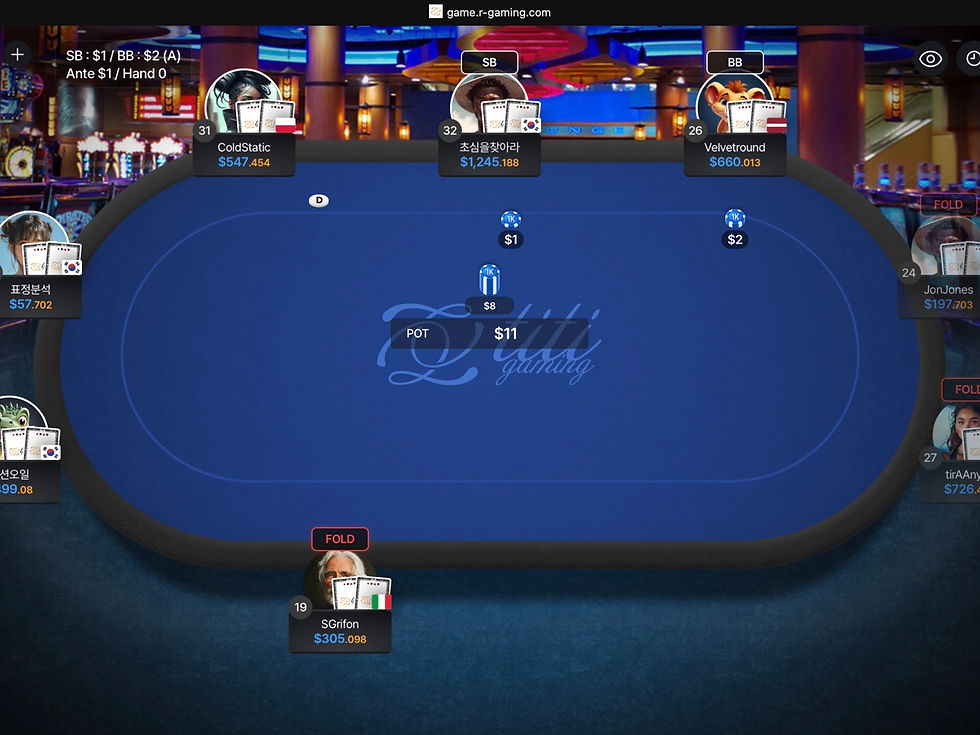
The difference is important: the 30% rate is the standard Poker Broker referral offer, while the higher rate is a private arrangement and should not be considered guaranteed for every account. We have also tested Titi Poker with real-money play; our early sessions found active cash tables and Korean recreational traffic, although we want a larger sample before drawing broader conclusions about long-term field quality.
Read our full Titi Poker Review for table screenshots, software testing, cashier details and our complete findings.
⚖️ High Rake + Soft Field vs Low Rake + Tough Field

Suppose Poker Room A has a very soft field, +18bb/100 pre-rake edge, 14bb/100 gross rake, 4bb/100 rewards, and a final expected winrate of +8bb/100.
Poker Room B is tougher, but gives you +10bb/100 pre-rake edge, 6bb/100 gross rake, 2bb/100 rewards, and a final expected winrate of +6bb/100.
Room A is better. The high rake is overcome by a larger player-to-player edge.
Now imagine recreational traffic weakens and your pre-rake edge on Room A falls from 18bb/100 to 12bb/100. Everything else stays the same. Your expected result falls to +2bb/100, making Room B clearly superior.
Nothing about the published rake table changed. Only the player pool changed.
🚨 The Rake Trap
A rake trap is not simply a room with high rake. A high-rake game can be fantastic if the opponents are bad enough.
The real trap appears when players overestimate the available edge. You see huge pots, high VPIP, limping, terrible showdowns, deep stacks and wild all-ins, and naturally assume: This game must be printing money.
Then you play 30,000 hands and the results disappoint. You blame variance. You play 70,000 and results are still mediocre. Eventually you inspect the database and realise you generated an enormous amount of rake.
The correct sequence is:
Soft game → estimate edge → measure rake → calculate rewards → evaluate final EV.
Not:
Soft game → immediately grind 200,000 hands.
🔎 How to Evaluate a Poker Game Before Grinding It
1. Check the official rake table
Find the rake percentage, cap, heads-up or short-handed cap, full-table cap, no-flop-no-drop policy and any extra fees.
2. Convert the cap into big blinds
Never evaluate the cap only in dollars. A $3 cap means very different things at NL50, NL100, NL200 and NL500.
3. Measure actual rake from your database
After a meaningful sample, check total rake, rake/100, bb/100 rake and rewards received. The published structure tells you what the room can charge; your database tells you what you actually paid.
4. Track effective rakeback
Do not use the advertised number. Use rewards actually received ÷ rake actually generated. That is your effective rakeback.
5. Estimate field quality
Look at average VPIP, obvious recreational players, reg-to-rec ratio, average stack, average pot, number of tables, peak-hour traffic and how frequently strong regulars battle each other.
6. Separate pre-rake and post-rake performance
A player winning only +1bb/100 after paying 11bb/100 may actually be producing a huge raw edge while the environment captures most of it.
7. Include rewards last
Then ask: Would I still choose this game if the promotion disappeared tomorrow?
🧠 What Professional Players Should Actually Compare
| Factor | Why It Matters | | --- | --- | | Field softness | Determines the potential skill edge | | Recreational traffic | Supplies most long-term ecosystem losses | | Rake % | Determines how quickly fees accumulate | | Rake cap | Controls the cost of larger pots | | bb/100 rake | Shows your actual cost | | Rakeback | Returns part of that cost | | Reward accessibility | Determines whether advertised rewards are realistic | | Game format | PLO, ante and action formats often generate more rake | | Stack depth | Deep games change pot sizes and cap dynamics | | Traffic | Determines table-selection opportunities | | Reg density | Determines how much edge remains after recreational losses are distributed |
There is no universally best poker room. A room can be excellent for one player and terrible for another.
The correct question is not simply Which site has the lowest rake? Nor is it Which site has the softest games?
It is: Where is the difference between my edge and my effective cost largest?
👉 For a real-world example of how rake, field strength and rewards can collide, read our CoinPoker 200NL controversy analysis.
✅ Final Thoughts
One of the biggest misconceptions in online poker is that soft games automatically equal profitable games.
They do not.
Soft opponents create potential edge. Rake determines how much of that edge you get to keep.
Sometimes a high-rake private game full of recreational players is enormously profitable. Sometimes it is a trap. Sometimes a lower-rake public pool full of competent regulars is worse. Sometimes rakeback turns a marginal game into an excellent grind. Sometimes a giant advertised rakeback percentage merely disguises an expensive underlying rake structure.
The only reliable approach is to measure everything: field quality + rake + caps + actual bb/100 paid + effective rakeback + traffic + game format.
The objective is not to find the room with the biggest headline bonus. It is to find the environment where the largest part of your poker edge stays in your bankroll instead of disappearing into rake.
If you are unsure whether the rake, field quality and rakeback of a poker room actually make sense for your game, contact The Poker Broker before committing significant volume.
❓ FAQ
Can a poker game really be too soft but still unprofitable?
Yes. A game can contain weak players but still provide very little profit if rake removes most of the available skill edge.
What is a good rake in bb/100?
There is no universal number. It depends on stake, format, table size, VPIP and playing style. The important number is your effective rake after rewards compared with your expected edge in that player pool.
Is 50% rakeback always a good deal?
No. Receiving 50% back from extremely high rake can still leave you paying more than a player receiving 20% rakeback on a cheaper structure.
Why is PLO rake often higher?
PLO players generally contest more pots, see more flops and play wider ranges, creating more raked pots and more pots that approach the cap.
Should I choose the poker site with the lowest rake?
Not necessarily. A low-rake room filled with strong regulars may offer less expected profit than a higher-rake room containing several weak players.
How do I know how much rake I am actually paying?
Analyse your playing history using tracking software where permitted. Measure rake over a meaningful sample, convert it into bb/100, then subtract the rewards actually received.
Can rakeback make a losing player profitable?
Yes. A player might lose slightly before rewards but become profitable after rakeback, leaderboards or other incentives.
What is more important: soft games or rake?
Neither should be analysed alone. The best game is generally the one where the difference between your expected skill edge and effective playing costs is greatest.
For access to private poker deals, room recommendations and rakeback options matched to your game, contact The Poker Broker on Telegram: @the_poker_broker.
