













What It’s Actually Like to Grind Red Dragon Poker for Four Days

Updated: Oct 16

If you’ve already read our Red Dragon Poker Review, you know how the software works, how to register, what D-Coins are and how the cashback system works.
This article is something completely different.
I wanted to answer a much more important question:
What are the games actually like?
Not after twenty hands.
Not after one lucky session.
After 5,346 real hands, played over four consecutive days, multi-tabling four tables, across different times of the day.
This isn’t a mathematical study and it certainly isn’t enough hands to draw conclusions about winrate.
But it is enough to understand how the games actually play, what kind of players you’ll face and whether Red Dragon feels different from the major international poker rooms.
The short answer?
Yes. Much different.
📚 Table of Contents
🎯 Why I Decided to Test Red Dragon Properly
One of the biggest problems with poker content today is that almost nobody actually plays.
Most reviews are simply rewritten versions of the official website.
You’ll usually find sections explaining:
the download page;
available bonuses;
supported devices;
payment methods.
Then comes a score.
9.3/10.
9.5/10.
9.7/10.
But very few articles answer the question poker players actually care about.
What happens when you finally sit down at the tables?
How does the field play?
Are people actually good?
Do they bluff?
Is the action real?
That’s why I decided to ignore the marketing and simply play.
For four consecutive days I played Red Dragon Poker almost exclusively, trying different hours, different tables and putting together a sample large enough to understand how this ecosystem behaves.
📊 My Test at a Glance
Here’s exactly what this article is based on.
Metric | Result |
Hands Played | 5,346 |
Days Tested | 4 |
Main Stakes | 2/4/8 (Ante 2) |
Tables Played | 4 simultaneously |
Sessions | Around 2 hours each |
Time Slots | Morning, afternoon and evening (European time) |
Game Profit | 7,368 Dragon Coins |
Additional Rakeback | Around 1,000 Dragon Coins |
Cashout Tested | ✅ Yes |
Withdrawal Time | Around 40 minutes to TRC20 wallet |
For transparency, roughly my first thousand hands were played at lower limits while I familiarised myself with the client.
The remaining sample comes almost entirely from the 2/4/8 (Ante 2) cash games.

💵 What Stakes Did I Actually Play?
One thing that initially confused me was the way Red Dragon displays its cash games.
Instead of calling tables NL50, NL100 or NL200, everything is shown using the blind structure in Chinese Yuan (CNY).
Here’s what the main No-Limit Hold’em limits currently look like.
Red Dragon Stakes | Straddle (CNY) | Approx. Straddle (USD) | Notes |
0.2 / 0.4 / 0.8 (0.2) | ¥0.8 | ~$0.12 | Entry level |
1 / 2 / 4 (1) | ¥4 | ~$0.59 | Small stakes |
2 / 4 / 8 (2) ⭐ | ¥8 | ~$1.18 | Main stake used for this test |
5 / 10 / 20 (5) | ¥20 | ~$2.95 | Mid stakes |
10 / 20 / 40 (10) | ¥40 | ~$5.90 | High stakes |
Approximate USD equivalents based on the current CNY/USD exchange rate.
At first glance, you might think:
“So this is basically NL100.”
Not even close.
That comparison is actually misleading.
On a full eight-handed table, before anyone even looks at their cards, the pot already contains:
Small Blind: 2 CNY
Big Blind: 4 CNY
Mandatory Straddle: 8 CNY
Eight Antes: 16 CNY
That’s 30 CNY already in the middle before action even starts.
Measured against the mandatory 8 CNY straddle, every hand begins with 3.75 big blinds already in the pot.
A standard cash game without antes starts with only 1.5 big blinds.
That means every single hand starts with roughly 2.5 times more dead money than a traditional Western cash game.
Now add another important factor.
Almost nobody buys in for 100 BB.
During my sample, the majority of players sat with 200 to 300 big blinds, while stacks above 500 BB were completely normal.
During some of the wildest sessions, especially during the European early morning, I even saw multiple players sitting with 1,000 BB or more.
So while the nominal blind structure looks relatively modest, the games actually play far bigger than most Western players would expect.

🐟 The First Thing That Surprised Me
I honestly expected to find a few obvious recreational players.
What I didn’t expect was how differently almost everyone approached poker.
Within the first few hundred hands I realised this wasn’t simply “PokerStars with weaker players.”
It almost felt like learning another population from scratch.
Ranges made very little sense.
People arrived at showdown with hands I wasn’t expecting.
Strong actions often represented completely different ranges from what I’m used to.
The biggest mistake you can make is assuming everyone is playing theoretically sound poker.
They’re not.
But that doesn’t necessarily make them easier to exploit immediately.
It simply means you need to recalibrate your assumptions.
🧠 Understanding the Player Pool
If I had to describe the average Red Dragon player in one sentence, I’d say this:
They would much rather gamble than fold.
Across more than five thousand hands, these were some of the most common tendencies I observed.
Limping is everywhere
Open limping is extremely common.
Much more common than on any major international site I’ve recently played.
But here’s the important part.
Don’t assume limps are weak.
I repeatedly saw players limp premium hands.
Limp-raises with AA and KK, but also JTs
One pattern that kept appearing was players trapping preflop.
Instead of raising immediately, they’d limp…
…wait for someone to isolate…
…and then suddenly come back over the top.
More than once I saw players turn over AA or KK after taking this line, and occasionaly some bluffs like JTs.
Cold-calling 3-bets with monsters
This was probably the strangest adjustment I had to make.
Several players would simply flat a 3-bet…
…only to back-raise all-in afterwards.
And when the cards were revealed?
AA.
KK.
Sometimes AK.
It’s a line you almost never see in reg-heavy Western pools.
Small pairs are treated like premium hands
Another recurring theme.
Players were perfectly happy stacking off preflop with hands like:
22
33
44
55
Often for surprisingly large amounts.
Preflop Stack-Offs Can Be Completely Unpredictable
The postflop calling tendencies were only part of the story.
I also witnessed preflop all-ins that would look almost unbelievable in a conventional online poker pool.
In one hand, an opponent was willing to commit approximately 600 big blinds preflop with J♠ J♣.
I held A♦ A♣, and the resulting pot was worth roughly 1,200 big blinds. Because of the extraordinary size of the pot, I chose to activate the insurance feature.
The board ran 10♥ 10♠ 7♥ 6♠ 9♥, and my aces held.

Getting all-in preflop with pocket jacks is not unusual when stacks are shallow. Committing around 600 BB, however, is an entirely different matter.
This was not a standard 100 BB cooler. It was an enormous deep-stack pot in which my opponent was prepared to risk several hundred big blinds before seeing a flop.
The second example was even more extreme from a range perspective.
After I opened with A♥ K♣, an opponent responded by directly shoving approximately 300 big blinds with K♠ 8♣ offsuit.
There was no complicated history or multi-street dynamic. He simply faced an ordinary opening raise and put his entire 300 BB stack into the middle with a dominated offsuit king.

The board ran J♥ 5♥ 7♠ A♠ K♥, and my A-K held in a pot exceeding 500 big blinds.
These two hands capture why Red Dragon can feel so disorienting for players coming from tighter international pools.
On most conventional poker sites, an opponent willing to play several hundred big blinds preflop would normally represent an exceptionally narrow range.
On Red Dragon, that assumption can make you fold far too often.
During my sample, some players were willing to gamble for enormous stacks with holdings ranging from medium pocket pairs to dominated offsuit hands. That does not mean every oversized shove is weak, but it does mean that bet size alone cannot be interpreted through normal Western population assumptions.
Top pair means “I’m calling”
One thing became obvious very quickly.
People simply don’t enjoy folding.
Top pair.
Weak kicker.
Second pair.
Overpairs.
Calls happen far more often than many Western regulars would expect.
If your strategy relies heavily on making people fold…
You’ll probably need to rethink it.
They Really Do Not Like Folding
One hand from my test perfectly illustrates how reluctant many Red Dragon players are to fold once they connect with the board.
An opponent opened preflop and called my 3-bet.
The flop came A♥ 2♣ J♠.
I continued with A♣ K♦, and he called.
The turn was the 2♠.
I bet again, and he called again.
The river brought the 7♠.
I fired a third value bet, and he still paid it off.
At showdown, my opponent revealed Q♣ J♥.
He had called a 3-bet preflop and then called all three streets with second pair on the flop, improving to two pair only because the board paired.
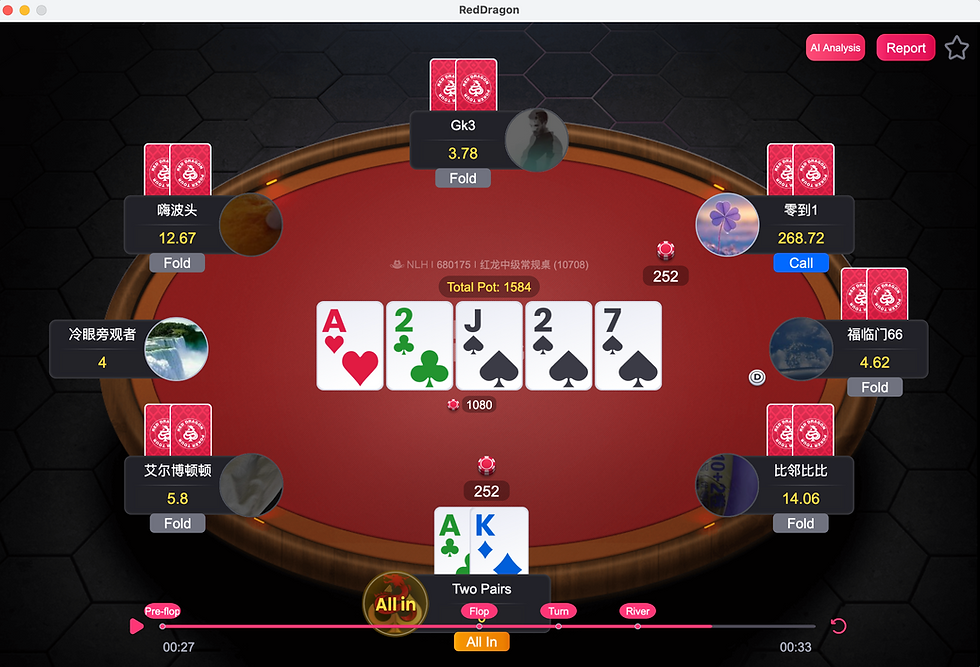

The final pot reached 1,584 CNY, or roughly $230, despite this being the 2/4/8 (Ante 2) level.
This hand captures one of the clearest tendencies I observed throughout my 5,346-hand sample:
once many players connect with the board, getting them to fold becomes extremely difficult.
This does not mean you should start value-betting recklessly in every spot. However, it does mean that standard Western assumptions about how much pressure marginal hands can tolerate may not apply here.
Against this player pool, thin value becomes more important, while ambitious multi-street bluffs can become much less attractive.
This is exactly why a regular arriving from a tighter international pool may initially feel disoriented. They may give opponents too much credit, check back too often or fold hands that are comfortably ahead of Red Dragon’s actual calling ranges.
💰 Deep Stacks Change Everything
The depth of the games completely changes the experience.
Unlike many online poker rooms where most players immediately top up to exactly 100 BB, Red Dragon feels much deeper.
Very quickly I noticed a pattern.
Most tables looked something like this:
several players around 200 BB
a few between 300 and 500 BB
occasionally someone sitting with 800 or even 1,000 BB
The result is obvious.
Single pots become enormous.
Turn decisions matter much more.
River mistakes become extremely expensive.
And because people don’t like folding…
Those massive pots actually happen.

🎲 Why These Games Feel Bigger Than NL100
This isn’t simply because the stacks are deeper.
It’s because everything pushes action in the same direction.
Mandatory antes.
Mandatory straddle.
Loose players.
Deep stacks.
Eight-handed tables.
Very little folding.
The combination creates an ecosystem where almost every orbit contains one or two genuinely huge pots.
Nominally you’re not playing nosebleeds.
Psychologically?
It often feels like you are.
🧠 Why Many Western Regulars Could Initially Struggle
This may sound counterintuitive.
I actually think many winning PokerStars regulars would struggle during their first few thousand hands here.
Not because the field is stronger.
Because they’d probably overfold.
When you’ve spent years playing disciplined player pools, you naturally learn to respect aggression.
On Red Dragon…
Aggression often means something completely different.
People stack off lighter.
People trap more.
People call far more often.
People show up with hands you simply don’t expect.
A technically solid Western regular could easily make several “correct” folds…
…that actually become mistakes against this particular population.
The challenge isn’t beating the field.
The challenge is understanding it first.
🚀 Want to Experience Red Dragon Poker Yourself?
After playing 5,346 real hands over four consecutive days, I’m convinced that Red Dragon offers one of the most exciting and unique No-Limit Hold’em ecosystems available today.
If you’d like to join the same games, register using our official Red Dragon partner link below.
⚠️ Important: Don’t Forget This Final Step
This step is required if you want us to:
✅ Activate your exclusive VIP cashback
✅ Link your account to The Poker Broker
✅ Provide ongoing support
✅ Help with deposits and withdrawals
Without your Player ID, we cannot associate your account with our VIP program, meaning we won’t be able to activate your cashback benefits.
⏰ The Morning Gamble Hour
One of the most interesting things I noticed had nothing to do with strategy.
It had to do with timing.
Playing across different European time slots, I realised that the atmosphere changes dramatically during the early European morning.
Tables become shorter.
Players begin moving up in stakes.
Massive stacks appear.
The games become noticeably wilder.
This is when I repeatedly encountered players sitting with 1,000 BB+, splashing chips around almost every orbit and creating enormous pots.
It almost feels like an unofficial “happy hour” for gamblers.
If you enjoy deep-stack poker with constant action, it’s probably one of the most entertaining times to play.
🖥️ Living With the Software for Four Days
When Red Dragon announced its rebuilt desktop client earlier this year, one of the main goals was clearly to attract higher-volume players by offering native Windows and macOS support, multi-tabling and a smoother overall experience.
After four days of grinding, I can honestly say the software exceeded my expectations.
I played almost the entire test four-tabling, and the client never crashed once.
Everything felt responsive, table switching was smooth, and I never experienced freezes or noticeable lag. For a relatively young client, stability was genuinely impressive.
What I liked
✅ Zero crashes during my test.
✅ Smooth four-table multitabling.
✅ Clean and modern interface.
✅ Fast action with very little waiting between hands.
✅ Time Bank was generous enough without slowing the games down.
For players who enjoy volume, the desktop client already feels perfectly usable.

What still needs improvement
The software isn’t perfect yet.
There are three things I’d like to see improved.
No waiting list
This is probably my biggest complaint.
When a table is full, you simply can’t join a waiting list.
You have to keep checking manually until somebody leaves.
For active cash-game grinders, that’s frustrating.
Bet button presets don’t stay saved
Every time I configured my preferred betting shortcuts, they eventually reverted back to the default values.
It’s not a huge problem.
It’s just annoying.
After the tenth time you start wondering why you’re configuring the same buttons again.
AI Analysis isn’t particularly useful
One of the headline features of the rebuilt client is its integrated AI hand analysis. The official client promotes built-in statistics, hand review and AI-assisted post-session analysis.
I tried it.
It’s interesting to look at.
But if you’re already studying poker seriously with modern tools, I don’t think you’ll gain much from it.
For recreational players it might be a nice introduction to reviewing hands.
For experienced grinders, I wouldn’t consider it a reason to choose Red Dragon.
📊 Traffic and Table Availability
One thing I deliberately tested was traffic.
Rather than logging in only during peak hours, I played throughout the day to see how active the ecosystem actually was.
Here’s one of the lobby snapshots I took during my test.
📷 Insert Lobby Screenshot Here
At 13:50 CET, the lobby showed:
408 players online
71 active NLH cash tables
69 players waiting or playing at my main 2/4/8 (Ante 2) limit
Obviously, this is only a snapshot, not a daily average.
Still, it gives a realistic idea of the amount of action available in the middle of the European day.
One thing I also noticed is that No-Limit Hold’em completely dominates the client.
Technically, PLO is available.
Practically, during my test it was almost nonexistent.
If you’re primarily a PLO player, this probably isn’t the room I’d recommend today.
If you’re an NLH player, it’s a very different story.
🌏 The Player Pool
Almost everyone I encountered was Asian.
That creates an ecosystem that feels very different from most European-facing poker rooms.
One thing I particularly appreciated was that I started recognising the same regulars after a few days.
That usually means people are actually grinding the games instead of constantly rotating through anonymous accounts.
Interestingly, there weren’t many strong regulars.
Most tables contained only one player who looked technically competent.
Everyone else simply wanted action.

💸 Dragon Coins, Rakeback and Rewards
During my test I finished with:
7,368 Dragon Coins in game profit;
roughly 1,000 additional Dragon Coins earned through rakeback.
It’s important to clarify one thing.
Those extra Dragon Coins were earned while playing, but I hadn’t yet claimed my rakeback when writing this article.
If you’re joining through a partner offering additional cashback or VIP benefits, your effective return can become even better.
That’s something worth considering if you’re planning to play significant volume.
💳 Deposit and Cashout Experience
Cashouts are one of the biggest concerns whenever someone tries a newer poker room.
Fortunately, my experience was very straightforward.
I tested a withdrawal to my TRC20 wallet.
The money arrived in approximately forty minutes.
No complications.
No unnecessary delays.
Obviously, one successful withdrawal doesn’t guarantee that every future withdrawal will always be processed in exactly the same time.
But based on my own experience, the process was smooth.
👍 Pros and Cons
👍 Pros | 👎 Cons |
Extremely soft NLH player pool (based on my sample) | No waiting list for full tables |
Deep-stack cash games | Bet button presets don’t always stay saved |
Four-table grinding feels smooth | PLO traffic is currently very limited |
Stable desktop client | AI analysis feels fairly basic |
Fast-paced games with very little tanking | Client still lacks a few quality-of-life features |
Quick cashout in my personal test | — |
⭐ Final Verdict
After four days and more than 5,300 hands, I think the most important conclusion isn’t that Red Dragon is soft.
It’s that Red Dragon is different.
Many poker players automatically assume that a softer field means they’ll immediately start printing money.
I don’t think that’s necessarily true.
In fact, I believe a technically solid Western regular could initially struggle here.
Not because the opponents are better.
Because they’re different.
People limp premium hands.
People cold-call 3-bets with monsters.
People refuse to fold.
People happily play 300 or 500 big blinds deep.
People gamble.
If you keep applying the exact same assumptions you use on PokerStars or GGPoker, you’ll probably overfold in situations where you’re actually far ahead.
Learning Red Dragon isn’t about abandoning good poker.
It’s about learning a different population.
And once you start understanding that population, the opportunities become very interesting.
Would I keep playing?
Absolutely.
The software still has room to improve.
The waiting-list system should be added.
The betting shortcuts need refinement.
The AI analysis isn’t particularly valuable.
But those are quality-of-life issues.
The games themselves are what matter.
And after four days, they’re the main reason I’ll continue playing.
📝 Final Thoughts
Red Dragon Poker surprised me.
Not because it has the flashiest software.
Not because of marketing.
Not because someone told me the games were soft.
It surprised me because, after more than 5,300 real hands, I found one of the most unique No-Limit Hold’em ecosystems I’ve played in recent years.
The mandatory ante changes everything.
The deep stacks create huge pots.
The player pool behaves very differently from what most Western grinders are used to.
If you’re looking for another copy of PokerStars, this isn’t it.
If you’re willing to adapt, observe and embrace a completely different style of poker, Red Dragon is well worth trying.
Ready to Play?
After spending four days and more than 5,346 hands on Red Dragon Poker, I’ll definitely continue grinding these games.
If you’d like to experience the same player pool, register through The Poker Broker using the official link below.
By joining through us, you’ll receive access to our exclusive VIP cashback program, personal assistance and direct support from players who actively grind the network.
Already registered through our link?
Great! The final step is to send us your Red Dragon Player ID on Telegram so we can link your account and activate your VIP cashback.
❓ Frequently Asked Questions
Is Red Dragon Poker actually soft?
Based on my personal sample of 5,346 hands, I found Red Dragon to have the softest No-Limit Hold’em player pool among the international poker rooms I currently play. That doesn’t mean you’ll automatically win, though. The games are very different from typical Western poker sites, and adapting to the player pool is essential.
Is Red Dragon Poker good for beginners?
Not necessarily.
The opponents make many mistakes, but the mandatory ante, deep stacks and unusual preflop dynamics create a game that can feel confusing if you’ve only played traditional online cash games.
What stakes did you play?
Almost all of my hands were played at 2/4/8 (Ante 2) No-Limit Hold’em tables.
Although the nominal straddle is worth roughly $1.18 USD, the combination of mandatory antes and deep stacks makes the games play significantly larger than a typical Western NL100 cash game.
How many hands did you play before writing this article?
This article is based on 5,346 real cash game hands played over four consecutive days.
I deliberately played during different European time slots while multi-tabling four tables to observe how the ecosystem changes throughout the day.
Did you test the cashout process?
Yes.
I tested a withdrawal to a TRC20 wallet, and the funds arrived in approximately forty minutes.
How good is the software?
Overall, I was pleasantly surprised.
The desktop client never crashed during my test, handled four-table multitabling smoothly and felt fast throughout.
There are still areas that need improvement, particularly the lack of a waiting list and the fact that betting shortcuts don’t always remain saved.
Is PLO active on Red Dragon Poker?
At the moment, not really.
During my test, almost all of the action was concentrated in No-Limit Hold’em. PLO technically exists within the client, but traffic was extremely limited.
Why do the games feel so different?
Several factors combine to create a unique ecosystem:
Mandatory antes.
Mandatory straddle.
Very deep average stack sizes.
Loose preflop tendencies.
Players who rarely fold.
Together, these create much larger pots and far more action than a typical Western online poker room.
Would a PokerStars regular immediately perform well?
Not necessarily.
One of the biggest adjustments is learning not to overestimate aggression.
Many players use unconventional lines, such as limp-raising premium hands or cold-calling 3-bets with AA or KK before back-raising all-in.
A technically strong player may initially overfold until they understand the population tendencies.
Would you continue playing on Red Dragon Poker?
Yes.
After more than 5,300 hands, I fully intend to continue playing.
The software still needs a few quality-of-life improvements, but the games themselves are among the most interesting and action-packed I’ve found on an international No-Limit Hold’em network.


