













US Poker Taxes 2026: Why Players Can Owe Tax Even When They Break Even

Updated: Oct 16

A poker player can finish 2026 without making a dollar of real profit — and still potentially have taxable gambling income.
That sounds impossible, but a change to US federal tax law has created exactly that situation.
Beginning with tax years after December 31, 2025, Section 165(d) limits deductible wagering losses to 90% of those losses, while still preventing the deduction from exceeding wagering gains.
For high-volume poker players, the difference can be enormous. Lawmakers are already trying to reverse the change, but as of October 2026 the 90% rule remains current federal law.
Important: This article is for general information only. It is not tax, legal or financial advice. US players should consult a qualified tax professional.
Table of Contents
🇺🇸 What Changed for US Poker Players in 2026?
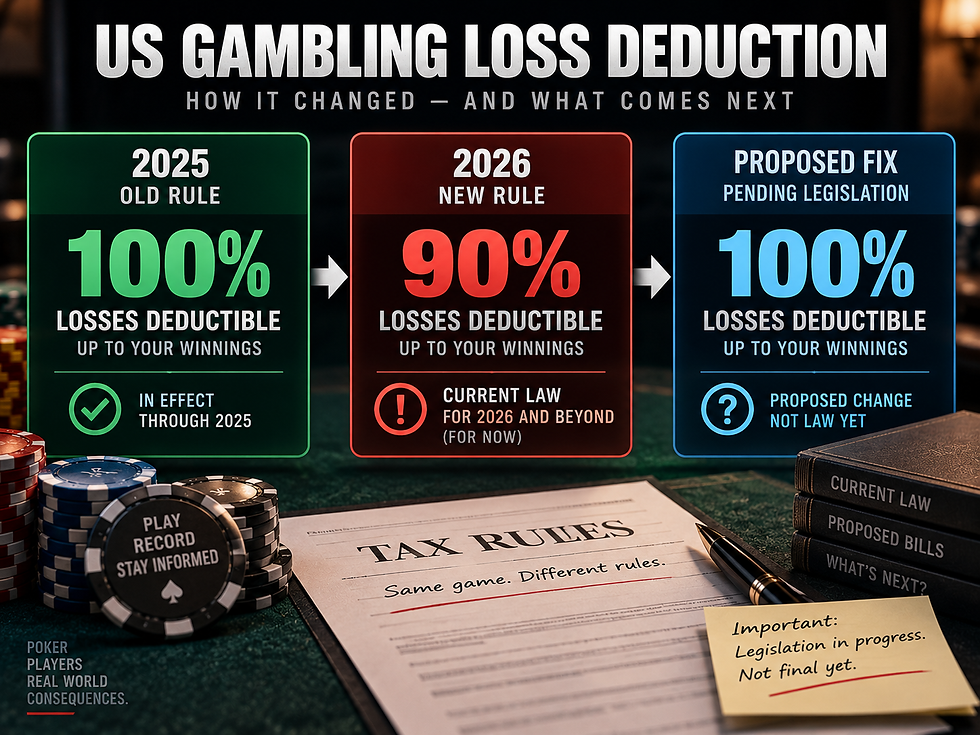
Until the end of 2025, federal law generally allowed wagering losses to be deducted up to wagering gains, subject to the applicable tax rules. The One Big Beautiful Bill Act changed Section 165(d).
For tax years beginning after December 31, 2025, the deductible amount is now limited to 90% of wagering losses, or wagering gains — whichever is lower.
That small-looking change can produce a strange result: a player does not necessarily need to be profitable to end up with gambling winnings that are not fully offset by the loss deduction.
💰 The $100,000 Break-Even Example
Imagine $100,000 in gambling winnings and $100,000 in gambling losses during 2026. Economically, the player broke even: real profit is $0.
But 90% of $100,000 in losses is $90,000. Under this simplified example, that leaves a $10,000 difference between winnings and the deductible-loss amount.
This does not mean the player automatically owes $10,000 in tax. It means $10,000 is not offset by the wagering-loss deduction. Actual tax liability depends on the player's complete tax situation.
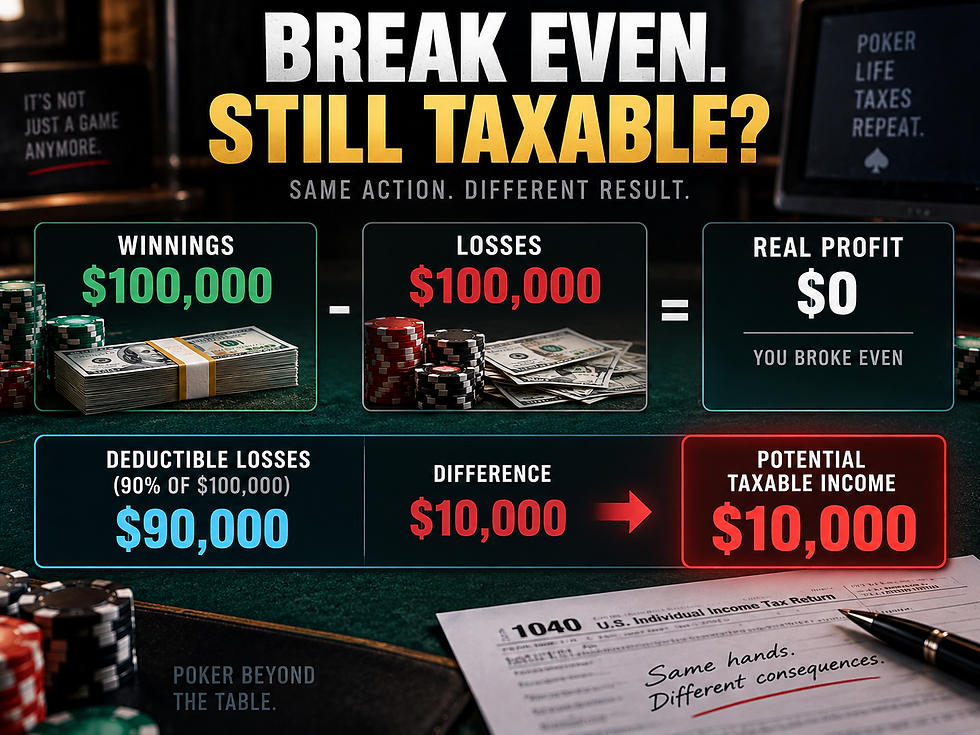
Scale the same example to $1,000,000 in winnings and $1,000,000 in losses and the economic result is still $0, but 90% of the losses is $900,000. The difference becomes $100,000.
♠️ Why Poker Players Can Be Hit Especially Hard
Poker is unusually exposed because gross activity and actual profit can be completely different numbers. A high-volume player can record very large amounts of wins and losses while earning only a small net profit.
For example, $550,000 in winnings and $500,000 in losses produces a real result of +$50,000. Yet 90% of $500,000 is $450,000, leaving a $100,000 difference against the winnings under the simplified calculation.
For grinders playing thousands of hands, frequent live tournaments or substantial online volume, this distortion can become much larger than it is for an occasional player.
📉 What If You Actually Lose Money?
Imagine $100,000 in winnings and $105,000 in losses. The real result is -$5,000. Yet 90% of $105,000 is $94,500, still below the $100,000 of winnings.
A player can therefore potentially finish the year down and still have gambling winnings that are not fully offset by the wagering-loss deduction.
👤 Recreational vs Professional Poker Players
The distinction between recreational and professional gambling remains important. Casual gamblers generally report gambling winnings as income and claim qualifying gambling losses as itemized deductions, subject to the applicable rules.
Professional gambling has different reporting considerations and can involve Schedule C and business expenses. The revised Section 165(d) also matters here, so substantial-volume players should obtain qualified tax advice rather than treating a simplified example as an individual tax calculation.
💻 Does This Apply to Online Poker?
The federal rule concerns wagering transactions rather than one specific form of gambling. Playing online instead of in a physical casino does not by itself make the issue disappear.
US players comparing platforms can start with our Best Poker Sites for USA Players guide.
Mobile players can also see our Best Real Money Poker Apps for US Players guide, while high-volume grinders should separately understand the value and mechanics covered in our Best Poker Rakeback Deals guide.
Do not confuse bankroll movements with taxable gambling results. A deposit is not automatically a loss, and a withdrawal is not automatically poker profit.
🧾 Keeping Accurate Poker Records Is More Important Than Ever
The IRS tells taxpayers claiming gambling losses to maintain accurate records of winnings and losses and supporting documentation. For poker players, useful records can include session logs, tournament buy-ins and results, room statements, cashier histories, receipts and account statements.
Crypto poker can add another layer because digital-asset transactions may create separate recordkeeping considerations.
Do not wait until tax season to reconstruct an entire year of poker activity. Organized records are far easier to maintain throughout the year than rebuild months later.
🏛️ Is Congress Trying to Reverse the Rule?
Yes. Several legislative efforts seek to restore the previous treatment, including the FAIR BET Act and the bipartisan FULL HOUSE Act.
On September 16, 2026, the House Ways and Means Committee advanced legislation containing a provision that would restore the full deduction for wagering losses up to wagering gains.
That does not mean the 90% rule has disappeared. A committee vote is not the same as a bill becoming law. As of October 2026, current Section 165(d) still contains the 90% limitation.
⏳ What Happens Next?
Congress could complete legislation restoring the previous 100% treatment. If the relevant change becomes law with an effective date covering 2026, the situation could change before many players file their 2026 returns in 2027.
Alternatively, the legislative process may not produce a change in time. Players should therefore follow developments rather than assume the proposed fix is already law.
We will update this article if the law changes.
🎯 Final Thoughts
Poker players normally think about profitability as money won minus money lost. US federal tax law in 2026 can produce a different calculation.
The reduction of the wagering-loss deduction from 100% to 90% means a player who breaks even — or in some circumstances finishes the year down — can potentially still have gambling winnings that are not fully offset by the loss deduction.
For now, the 90% limitation is current law for the 2026 tax year. Players generating meaningful volume should keep detailed records and speak with a qualified US tax professional about their individual situation.
❓ Frequently Asked Questions
Can a poker player owe federal tax after breaking even in 2026?
Potentially, yes. Equal winnings and losses can still leave an amount that is not offset by the loss deduction under the current 90% calculation.
When did the new rule start?
It applies to tax years beginning after December 31, 2025, so it affects the 2026 tax year.
Can I still deduct poker losses?
Yes, subject to the applicable rules. Section 165(d) generally limits the amount to 90% of wagering losses and also prevents the deduction from exceeding wagering gains.
Has the 90% rule already been repealed?
No. As of October 2026 it remains federal law. Legislation seeking to restore the full deduction has advanced, but the change has not yet become law.
Is this article tax advice?
No. It provides general information for poker players. Federal and state tax treatment depends on individual circumstances.


