










USDT and USDC Networks for Online Poker: TRC20 vs ERC20 vs BEP20 vs Solana vs Polygon

Updated: Oct 16
If you’ve played on crypto poker rooms for a while, you’ve probably noticed that depositing or withdrawing stablecoins isn’t as straightforward as it used to be.
Not long ago, the decision was simple: almost everyone recommended USDT on TRC20. It was supported by nearly every poker room, transaction fees were low, and moving funds between exchanges, wallets and poker sites was quick and inexpensive.
Today, the situation is very different.
Ethereum gas fees have fallen dramatically compared to previous years, newer networks like Solana and Polygon are becoming more common, and TRON itself has introduced solutions such as GasFree Wallets that completely change how transaction fees work.
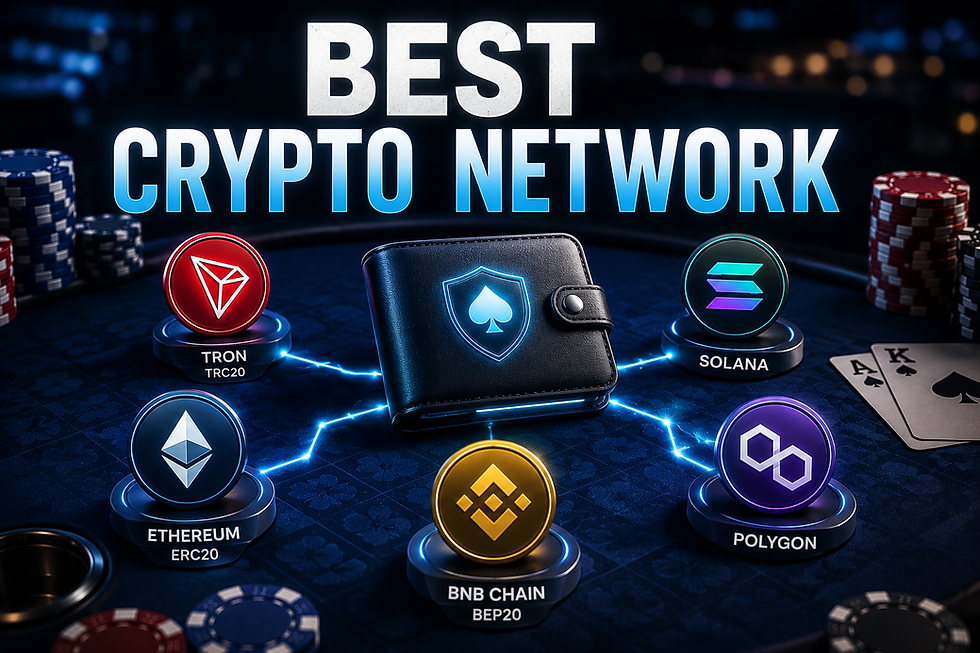
At the same time, poker rooms haven’t adopted these networks equally. Some only support TRC20, others offer ERC20 and BEP20, while only a handful currently accept Solana or Polygon. Choosing the wrong network may not only increase your costs, but also lead to failed deposits or withdrawals if the receiving platform doesn’t support the blockchain you’ve selected.
So, which network should you actually use?
The answer depends on three factors:
Which networks your poker room supports.
Which networks your exchange or wallet supports.
The real cost of moving funds today—not what was true two or three years ago.
This guide compares the five networks that matter most to online poker players, explains their strengths and weaknesses, and helps you choose the right option for your specific situation.
📚 Table of Contents
💡 The Short Answer
If you only read one section of this guide, make it this one.
For most poker players, TRC20 and ERC20 are still the only two networks you really need to know.
TRC20 remains the most widely supported network across online poker. Whether you’re playing on Asian poker apps, private clubs or independent crypto poker rooms, there’s a good chance you’ll find USDT on TRON available for both deposits and withdrawals.
However, our preferred choice today is ERC20 whenever it’s available.
Why?
Because Ethereum has changed considerably over the last few years.
Gas fees are no longer consistently expensive, support across exchanges and wallets is virtually universal, and almost every major crypto user already has an ERC20-compatible wallet.
In our opinion, ERC20 currently offers the best combination of:
Excellent compatibility.
Strong security.
Broad wallet support.
Low on-chain fees at the time of writing.
That doesn’t mean TRC20 is a bad option.
Quite the opposite.
If compatibility is your priority, TRC20 is still incredibly difficult to beat.
Networks such as BNB Smart Chain, Solana and Polygon are technically excellent and often cheaper on-chain, but they’re still supported by far fewer poker rooms.
Our current ranking looks like this:
Network | Our Verdict |
🥇 ERC20 | Best overall choice today. |
🥈 TRC20 | Best compatibility across online poker. |
🥉 BEP20 | Excellent when supported. |
4️⃣ Solana | Outstanding technology, limited adoption. |
5️⃣ Polygon | Very promising, but still uncommon in poker. |
Remember one important thing:
The cheapest blockchain doesn’t always result in the cheapest withdrawal.
We’ll explain why later in this guide.
🌐 Why Choosing the Right Network Matters
Imagine you’ve just won a tournament and it’s time to cash out.
You click Withdraw and the poker room gives you several options:
USDT (TRC20)
USDT (ERC20)
USDT (BEP20)
USDC (ERC20)
USDC (Polygon)
For many players, they all look identical.
After all, they’re still sending USDT or USDC, right?
Not exactly.
The stablecoin remains the same, but the blockchain carrying that transaction changes completely.
Think of it like sending money through different courier companies.
The package is identical.
The delivery network isn’t.
Each blockchain has its own:
transaction fee;
confirmation speed;
wallet compatibility;
exchange support;
poker room adoption.
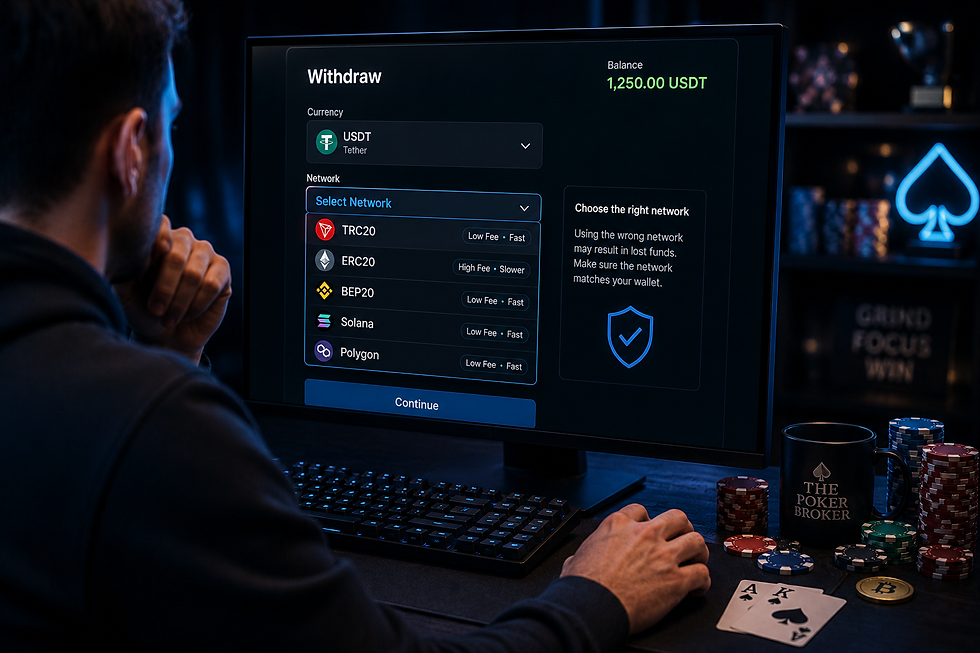
Choosing the wrong network doesn’t necessarily mean you’ll lose your money, but it can create unnecessary problems.
For example, if your exchange expects USDT on ERC20 and you accidentally send USDT on TRC20, the deposit won’t arrive automatically because the receiving platform is looking for funds on a completely different blockchain.
Recovering that transaction may require contacting customer support, waiting several days or paying additional recovery fees. In some cases, recovery may not even be possible.
Fortunately, avoiding these mistakes is easy.
Before confirming any transfer, always check that both the sender and the receiver support exactly the same network.
It takes only a few seconds and can save you a great deal of time and money.
🔵 TRC20 (TRON)
If online poker had a “default” blockchain, it would probably be TRON.
For years, USDT on TRC20 has been the standard choice across much of the poker industry, particularly within Asian poker apps, private unions and agent-based ecosystems.
Even today, it’s still the network you’ll encounter most often.
One of the biggest reasons for TRON’s popularity is compatibility.
Almost every major cryptocurrency exchange supports TRC20 deposits and withdrawals, and countless poker rooms have adopted it as their primary payment network.
That alone makes TRC20 an extremely practical option.
✅ Pros
The most widely supported USDT network in online poker.
Supported by virtually every major exchange.
Fast confirmations.
Easy to use for beginners.
❌ Cons
The idea that TRC20 is always the cheapest option is no longer accurate.
While it was once significantly less expensive than Ethereum, today’s reality is more nuanced.
If you’re sending USDT directly without Energy or staking, transaction costs can be much higher than many players expect.
Fortunately, TRON has also introduced new solutions such as GasFree Wallets, making the ecosystem easier to use than ever before.
We’ll look at both Energy and GasFree in detail later because they’re important for anyone who regularly moves funds between poker rooms and exchanges.
🏆 Our Verdict
If maximum compatibility is your priority, TRC20 is still one of the safest choices available.
For players using private poker clubs or agent-based ecosystems, it’s often the obvious option.
⚪ ERC20 (Ethereum)
Ethereum has undergone a remarkable transformation.
For many years, poker players avoided ERC20 because transaction fees could become extremely expensive during periods of network congestion.
That reputation has survived much longer than the actual problem.
Today, Ethereum gas fees are often surprisingly reasonable, making ERC20 one of the most attractive options available.
More importantly, ERC20 is supported almost everywhere.
Whether you’re using Binance, Kraken, Coinbase, Ledger, MetaMask or another major wallet, compatibility is rarely an issue.
Ethereum is also the native home of both USDT and USDC, making it one of the safest long-term choices for stablecoin transfers.
✅ Pros
Excellent exchange support.
Outstanding wallet compatibility.
Native support for USDT and USDC.
Currently low on-chain transaction costs.
❌ Cons
The biggest downside isn’t Ethereum itself.
It’s the fees charged by exchanges and poker rooms.
Many operators still apply fixed withdrawal fees that have little to do with Ethereum’s actual blockchain costs.
That’s why comparing gas fees alone can sometimes give a misleading picture.
🏆 Our Verdict
If both TRC20 and ERC20 are available, ERC20 would currently be our first choice.
The combination of broad compatibility, strong security and today’s relatively low gas fees makes it, in our opinion, the most versatile network for online poker players.
🟡 BEP20 (BNB Smart Chain)
BNB Smart Chain is often overlooked by poker players, but it deserves far more attention than it usually receives.
From a technical perspective, it’s an excellent blockchain.
Transactions are generally inexpensive, confirmations are fast and virtually every major exchange supports BEP20 deposits and withdrawals.
So why isn’t it more popular in online poker?
Simply because relatively few poker rooms currently support it.
Unlike TRC20 and ERC20, which have become industry standards, BEP20 is still offered by a smaller number of operators.
Whenever it’s available, however, it’s a perfectly valid option.
Just remember to check that both the poker room and your receiving wallet support exactly the same BEP20 token, particularly when using USDC, where multiple representations may exist depending on the platform.
✅ Pros
Very low transaction costs.
Fast confirmations.
Excellent exchange support.
❌ Cons
Limited adoption across poker rooms.
Users should pay close attention to the selected token and network.
🏆 Our Verdict
BEP20 is a network we’d happily use whenever it’s supported.
The only reason it doesn’t rank higher is that support across the poker industry is still relatively limited compared to TRC20 and ERC20.
🟣 Solana
In terms of technology, Solana is arguably one of the most impressive blockchains available today.
Transactions are confirmed in seconds, network fees are typically a fraction of a cent, and the overall user experience has improved significantly thanks to wallets such as Phantom and Backpack.
If online poker only cared about technology, Solana would probably rank near the top.
The problem is compatibility.
While most major exchanges now support both USDT and USDC on Solana, relatively few poker rooms currently allow deposits and withdrawals through the network. As a result, many players simply don’t have the opportunity to use it.
That may change over the coming years, but for now Solana remains a niche option in the poker industry.
✅ Pros
Extremely low on-chain transaction fees.
Very fast confirmations.
Excellent wallet ecosystem.
Strong security and growing adoption.
❌ Cons
Limited support across poker rooms.
Rarely available in private clubs and agent-based ecosystems.
🏆 Our Verdict
If your poker room supports Solana, don’t hesitate to use it.
The technology is excellent.
The only reason we don’t rank it higher is because support across the poker industry is still relatively limited.
🟢 Polygon
Polygon offers many of the same advantages as Solana.
Transactions are inexpensive, confirmations are quick and the network is supported by virtually every major exchange.
Like Ethereum, Polygon has also become an increasingly popular blockchain for stablecoins.
However, there’s one small complication.
Depending on the platform you’re using, you may encounter different versions of USDC or USDT, including native tokens and bridged variants.
Most players don’t need to understand the technical details behind these implementations.
The important thing is simply to choose exactly the same network requested by your poker room or exchange.
If both sides specify Polygon, you’re good to go.
✅ Pros
Extremely low fees.
Fast confirmations.
Excellent exchange support.
Growing ecosystem.
❌ Cons
Limited adoption across online poker.
Stablecoin versions can sometimes confuse beginners.
🏆 Our Verdict
Polygon is another blockchain with enormous potential.
If more poker operators begin supporting it over the next few years, it could easily become one of the best options available.
💰 Network Fees Explained
One of the biggest mistakes players make is assuming that the blockchain fee is the total cost of a withdrawal.
In reality, three completely different fees may be involved.
Blockchain (Gas) Fee
This is the fee paid to process the transaction on the blockchain itself.
It goes to the network—not to your poker room or exchange.
The amount changes constantly depending on network activity.
Exchange Withdrawal Fee
If you’re withdrawing from Binance, Kraken, Bybit or another exchange, the platform may charge its own withdrawal fee.
This fee may be:
higher than the blockchain cost;
lower than the blockchain cost;
or exactly the same.
Every exchange has its own policy.
Poker Room Withdrawal Fee
Poker rooms can also apply their own withdrawal fees.
Some simply pass on the blockchain cost.
Others charge a fixed amount regardless of the network.
Agent-based ecosystems may not charge a blockchain fee directly at all, as withdrawals are often handled manually by the cashier.
This is why comparing blockchain fees alone doesn’t always tell the full story.
🔥 TRON Energy & GasFree Explained
One reason TRON confuses many players is that there are several different ways to pay transaction fees.
Paying with TRX
The simplest option.
If your wallet doesn’t have enough Energy available, TRON burns TRX to process the transaction.
Staking TRX
By staking TRX, users receive Energy that can significantly reduce future transaction costs.
This solution is ideal for players who move funds regularly.
Renting Energy
Some services allow users to rent Energy instead of staking their own TRX.
Heavy users often choose this approach because it can reduce costs compared to paying the full network fee every time.
GasFree Wallets
GasFree is one of the biggest recent improvements to the TRON ecosystem.
Instead of requiring TRX, compatible wallets allow users to pay the fee directly in USDT.
This makes the process much simpler for casual users.
However, one important misconception should be cleared up.
GasFree doesn’t mean free.
It simply means you don’t need to own TRX to complete the transaction.
The wallet still displays the applicable fee before you confirm the transfer.

🃏 Which Networks Do Poker Rooms Support?
Support changes over time, but the overall picture currently looks like this.
Network | Poker Room Support | Notes |
TRC20 | ⭐⭐⭐⭐⭐ | The industry standard for USDT. |
ERC20 | ⭐⭐⭐⭐☆ | Widely supported by major operators. |
BEP20 | ⭐⭐⭐☆☆ | Growing, but still limited. |
Solana | ⭐⭐☆☆☆ | Supported by relatively few rooms. |
Polygon | ⭐⭐☆☆☆ | Similar to Solana. |
🏆 Which Network Should You Choose?
Every player has slightly different priorities.
Here’s what we’d recommend.
If compatibility matters most
Choose TRC20.
It’s still the safest option across the widest number of poker rooms.
If you want the best overall balance
Choose ERC20.
At the time of writing, Ethereum gas fees remain surprisingly low and compatibility is outstanding.
If your poker room supports it
Don’t be afraid to use BEP20, Solana or Polygon.
All three offer excellent technology and very low blockchain costs.
The only drawback is that support across poker operators remains limited.
💬 Final Thoughts
There isn’t a single blockchain that’s perfect for every poker player.
The best choice depends on where you’re depositing, where you’re withdrawing and which networks both platforms support.
That said, if we had to recommend just two networks to the vast majority of players, they’d still be TRC20 and ERC20.
TRC20 remains the king of compatibility and is likely to stay that way for some time.
ERC20, however, has quietly become our favourite thanks to its excellent wallet support, widespread adoption and much lower transaction costs than many players still expect.
As the poker industry continues adopting newer blockchains, we’ll keep this guide updated to reflect the latest changes.
❓ Frequently Asked Questions
Which network is best for online poker?
For most players, ERC20 and TRC20 remain the best choices due to their excellent compatibility across poker rooms, exchanges and wallets.
Is TRC20 still the cheapest network?
Not necessarily.
Without Energy or staking, TRON transactions can be more expensive than many players expect. Always compare the actual withdrawal cost before sending funds.
Is ERC20 expensive?
Not anymore.
Ethereum gas fees are currently much lower than they were a few years ago, making ERC20 one of the most practical options available.
Should I use Solana or Polygon?
If your poker room supports them, absolutely.
Both networks are fast and inexpensive, although they’re still less widely supported than TRC20 and ERC20.
Can I send USDT using a different network than the one requested?
No.
Always make sure the sending and receiving networks match exactly.
Sending funds through an incompatible blockchain may require manual recovery—or, in some cases, could result in permanent loss of access to the funds.