













ClubGG Rakeback Changes in 2026: Are Winning Players Getting Less?

Updated: Oct 16

Imagine grinding the same stakes, generating the same amount of rake, and playing under the same 40% rakeback deal you have always had.
At the end of the week, however, your rakeback is lower.
Your agent hasn't necessarily changed your percentage. The tables haven't necessarily become more expensive. And you haven't necessarily played fewer hands.
What changed is the way the rake generated at those tables gets attributed to you.
Since August 5, 2026, ClubGG has allowed club and union operators to adjust how chip rake contribution is distributed between players. At one extreme, the system follows each player's contribution to the pot. At the other, the entire rake contribution is assigned to players who lost.
It is a significant change for anyone whose private rewards depend on contributed rake.
The update has already sparked debate on the Two Plus Two forums, where some players fear an erosion of winning regulars' rakeback while others consider it a useful way to reward recreational players.
But how much difference can the new system actually make?
And, perhaps more importantly, does a 50% rakeback deal still mean what players think it means?
Table of Contents
🎯 What ClubGG Changed on August 5
On August 5, 2026, ClubGG released an update aimed primarily at club and union administrators.
Among the new features were Agent Win/Loss Limits, automatic EV Cashout rejection and several operational improvements.
However, one particular feature deserves much more attention than the others.
Chip Rake Allocation.
Previously, the conventional contributed-rake approach attributed rake according to the amount each participating player contributed to a pot.
ClubGG now allows operators to choose how much of that rake contribution should instead be attributed to losing players.
The platform's official announcement describes the following settings:
Allocation setting | How rake contribution is distributed |
0% | Based entirely on each player's contribution to the pot |
10%–90% | Selected percentage assigned to losing players; remainder follows pot contribution |
100% | Entire rake contribution assigned to losing players |
This is not an automatic change applied identically to every union. The setting is configurable, and different unions can make different choices.
ClubGG also confirmed that within a union, the setting is controlled by the Union Master Club and applies to all affiliated sub-clubs.
That distinction is essential.
Two players using the same ClubGG application, paying the same underlying table rake and advertising identical rakeback percentages could potentially receive very different rewards depending on their union's allocation settings and private arrangements.
💰 Rake Charged vs Rake Allocated: The Difference That Matters
Before going further, we need to separate three different concepts.
Rake charged is the fee taken from a poker pot under the game's rake structure.
Rake allocated is the portion of that fee attributed to a particular player for reporting and accounting purposes.
Rakeback paid is whatever reward the player actually receives under a separate applicable agreement.
These are not interchangeable.
The August ClubGG update concerns the second calculation: rake allocation.
It does not, by itself, establish that ClubGG increased the amount of rake removed from pots across the platform.
This distinction is particularly important for players accustomed to receiving rakeback calculated from contributed rake.
A player can still participate in the same games and generate the same total table rake while receiving a different share of the recorded rake contribution.
And if their rakeback depends on that recorded contribution, their eventual reward may change too.
We previously explained the broader differences between reward calculation methods in our guide to Dealt vs Contributed Rakeback.
ClubGG's update introduces another important variable: a configurable redistribution of the credited contribution toward players who lose pots.
🧮 How the New ClubGG Rake Allocation System Works
The easiest way to understand the change is through a simple two-player example.
Suppose a cash-game pot generates 5 chips of rake.
Player A wins the pot and contributed 60% of the chips placed into it.
Player B loses and contributed the other 40%.
Under a contribution-weighted allocation system, Player A would receive 60% of the credited rake and Player B would receive 40%.
Now look at what happens under different allocation settings.
Rake allocation | Player A: Pot winner | Player B: Pot loser |
0% | 3.00 | 2.00 |
50% | 1.50 | 3.50 |
100% | 0.00 | 5.00 |

Illustrative calculation using 5 rake units, two players and the allocation proportions published by ClubGG. It is not an actual ClubGG hand history or union settlement report.
At 0%, everything follows pot contribution.
At 50%, half the rake credit follows the original contribution calculation while the other half is assigned to the losing player.
At 100%, the winning player receives no rake contribution credit for that pot.
The total rake remains exactly 5 chips in every scenario.
Nothing extra has been taken from the table.
The entire difference is in who receives credit for the rake already generated.
That might sound like a technical accounting detail. For a player whose rakeback is calculated from credited rake, it can be financially significant.
📉 A Realistic Rakeback Calculation: Same Deal, Different Reward
Now suppose both players have a hypothetical agreement returning 40% of their individually credited rake contribution.
Using the same hand:
Allocation | Player A: 40% reward | Player B: 40% reward |
0% | 1.20 | 0.80 |
50% | 0.60 | 1.40 |
100% | 0.00 | 2.00 |
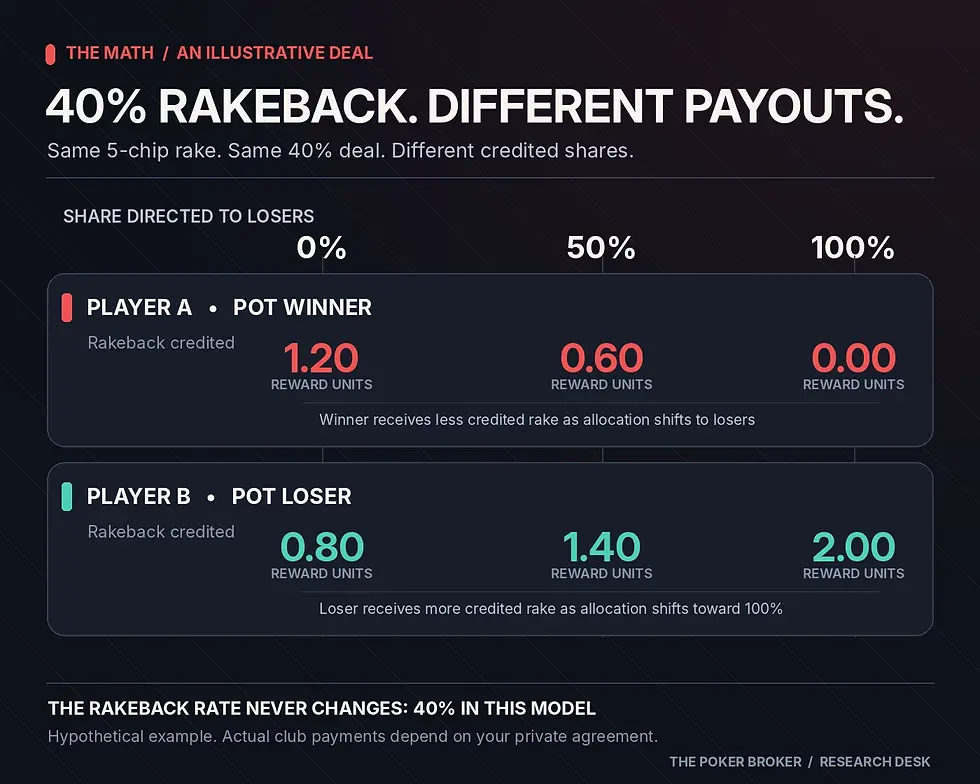
In this example, Player A's potential reward falls from 1.20 units to zero.
Player B's potential reward rises from 0.80 to 2.00 units.
The headline rakeback percentage never changes. It is still 40%.
What changes is the amount to which that 40% is applied.
These figures illustrate the mechanics, not a guarantee of actual ClubGG payouts. Real private arrangements can use different calculations, settlement rules and reward conditions.
Nevertheless, the example shows why a percentage alone is no longer enough information to evaluate a contributed-rake deal.
Consider the difference between these two statements:
You receive 40% rakeback.
You receive 40% of the rake contribution attributed to you under your union's current allocation settings.
They can describe very different economic arrangements. And the distinction becomes especially relevant for regulars playing substantial volume.
🃏 Are Winning Regulars Being Penalized?
This is where the discussion becomes more complicated.
At first glance, the new system appears unfavorable to players who win pots and favorable to those who lose them.
But there is an important distinction between winning an individual pot and being a long-term winning poker player.
A successful regular still loses plenty of individual hands. Likewise, an overall losing recreational player can win large pots.
The new allocation method should therefore not be interpreted as a simple division between permanently classified winners and losers.
Its economic effect depends on the actual distribution of pot results, participation and credited rake over time.
A strong regular who wins a large share of the relevant raked pots may receive less contributed-rake credit than under the previous method. But the precise impact requires real playing and accounting data.
We cannot simply claim that every professional player now receives less rakeback. We also cannot assume that every union has selected a high losing-player allocation percentage.
The risk is real, but the impact is union-specific and player-specific.
For grinders relying on rakeback to maintain their profitability, even a relatively modest adjustment can matter.
As we explained in Poker Rake in 2026: Why Even Soft Games Can Be Unbeatable, a game does not become profitable merely because its opponents are weak.
The actual cost of playing and the value of rewards remain crucial components of expected winrate. And if those rewards become smaller, the economics of the game change.
💬 What Players Are Saying on Two Plus Two
The ClubGG change attracted attention in the Online Poker Sites section of the Two Plus Two forums.
On August 13, a contributor using the name sturutter raised concerns about the new system.
The player suggested that shifting rake attribution toward losing players could substantially reduce the effective rakeback earned by winning regulars.
They also compared the potential effect with the Player Value Index used by GGPoker.
The most interesting part of the complaint, however, was not simply the possibility of receiving less rakeback. It was the lack of clarity about which allocation percentage a particular union was using.
If players do not know the setting behind their reward calculation, how can they reliably compare offers?
On August 17, another forum participant, VANGET, offered a different perspective.
The contributor argued that similar approaches had existed on other club-based poker applications and that directing more rewards toward losing players could be beneficial.
That position raises a legitimate question: is rewarding recreational players necessarily bad for the poker ecosystem?
Not always. A system that helps recreational players maintain their balances could potentially support healthier games over time.
But that is a possible economic argument, not proof that the allocation change will actually improve traffic or player retention. And it does not eliminate the need for transparency.
There is a major difference between openly telling players that rewards favor losing participants and advertising an attractive rakeback percentage without clearly explaining how its underlying contribution is calculated.
Our concern is not that different players might receive different rewards. It is whether they understand the terms before they start playing.
🏦 Why Your ClubGG Union Matters More Than Ever
The August update makes union selection more important for players who depend on rakeback.
ClubGG's official documentation states that the Union Master Club controls rake allocation for its affiliated sub-clubs.
This means that an individual sub-club operating inside a union cannot independently select a different allocation percentage.
It also means an agent may be offering a rakeback agreement while having no direct control over the underlying allocation setting.
There are now several things players need to evaluate together: the actual rake structure of the games, the quality of the player pool, the union's allocation settings, the reward calculation method and the reliability of the people managing the arrangement.
A high headline rakeback percentage is only one part of that evaluation.
We have already examined how much difference the player pool can make in our TGB Union traffic and gameplay analysis.
And our Massiv Union ClubGG Review examines another established name in the ClubGG ecosystem.
Neither article should be taken as a current certification of a particular union's rake allocation percentage. Those settings need to be checked separately.
Selecting a poker union based exclusively on the highest advertised rakeback percentage can be a mistake.

🔍 How to Check Your Actual ClubGG Rakeback
So what should a player do?
The first step is to ask their agent or union operator one specific question:
What is the current Chip Rake Allocation percentage used by my union?
A useful answer should identify the actual setting, rather than simply repeat the rakeback percentage being advertised.
The second question is equally important:
Is my rakeback calculated from the rake contribution recorded under that setting, or from a separate calculation?
Some private arrangements may use the affected credited-rake figure directly. Others may use alternative formulas or offer rewards that are not directly linked to that field.
Without knowing the actual agreement, it is impossible to determine the precise financial impact.
Players should also ask whether the setting can change during future settlement periods and how they will be informed if it does.
Where detailed records are available, comparing them is more valuable than relying on estimates.
The useful figures include the number of hands played, total rake recorded for the relevant games, the contribution credited to the player, the applicable reward percentage and the final amount paid.
ClubGG provides reporting tools for administrators, including its Union Back Office. The availability of specific reports to individual players may depend on their access and the cooperation of their club or union operator.
One caution is necessary when comparing older and newer reports.
A difference in credited rake does not automatically prove that the allocation setting changed. Volume, stakes, pot sizes and results can all change the figures independently.
The strongest comparison is one that combines the underlying playing data with the actual allocation setting used during each period.
⚖️ Is This the Same as GGPoker's PVI?
Several players have compared ClubGG's new allocation system to GGPoker's Player Value Index, or PVI.
The comparison is understandable.
Both discussions involve a similar economic concern: the possibility that a player's visible poker activity does not translate into the amount of reward credit they expect.
However, treating the two systems as identical would be misleading.
ClubGG has publicly described a specific adjustable allocation mechanism tied to pot contribution and losing players.
PVI is a different reward-adjustment framework. The formulas, control mechanisms and available information are not interchangeable.
What they share is a larger problem for players evaluating poker rewards.
An advertised rakeback percentage tells you very little unless you understand the calculation behind it.
A 50% deal applied to one contribution figure might be less valuable than a 35% deal applied to another. That is why the effective financial return matters more than the headline percentage.
🏁 Final Thoughts: The Real Issue Is Transparency
ClubGG's August 5 update does not automatically make the application worse for every poker player.
It also does not establish that the platform has universally increased the rake charged at its tables.
What it does is introduce an additional variable into the calculation of rake contribution.
And for players whose private rewards depend on that figure, the variable can matter enormously.
Some union operators may use the flexibility to direct more credit toward players losing pots. Others may prefer to preserve a contribution-weighted model.
Both approaches have potential economic arguments behind them. But players deserve to understand which system they are participating in.
A professional grinder needs accurate information to evaluate expected returns. A recreational player should also understand whether an apparently generous reward actually applies to their activity. And agents should be able to explain how their advertised deals are calculated.
We have verified ClubGG's official announcement and the public reactions from players. We have not independently audited settlement data from every union or established how widely each allocation setting is currently used.
For now, the conclusion is straightforward.
ClubGG rakeback did not necessarily become worse for everyone. It became more important to understand exactly how it is calculated.
And a rakeback percentage without a clearly defined calculation method is no longer enough.
If you are evaluating a ClubGG union or want help understanding a private poker deal, [contact The Poker Broker on Telegram](https://t.me/the_poker_broker).
We can help you compare the available terms, game conditions and reward structures before you make a decision, subject to applicable rules and availability.
❓ Frequently Asked Questions
Did ClubGG increase rake in August 2026?
The August 5 update introduced configurable rake allocation. It did not announce a universal increase to the percentage or amount of rake taken from every pot.
What is ClubGG Chip Rake Allocation?
It is an administrative setting that determines how generated chip rake is attributed between players. Operators can assign a portion of the contribution credit to losing players rather than distributing everything according to pot contribution.
What happens when ClubGG Rake Allocation is set to 100%?
According to ClubGG's announcement, all rake contribution is allocated to losing players. In a two-player example, the winner of the pot receives no credited contribution for that hand.
Does the new system reduce rakeback for winning players?
It can reduce the contribution credited to players who win pots. Whether it reduces a player's actual rakeback depends on the union's setting, the player's hand results and the formula used by their private reward agreement.
Can individual clubs choose their own allocation settings?
For clubs operating within a union, ClubGG states that the Union Master Club controls the setting and applies it across affiliated sub-clubs. Standalone clubs have their own administrative configuration.
Is ClubGG Rake Allocation the same as PVI?
No. Some players have compared the economic effects, but ClubGG's configurable contribution-allocation mechanism is not the same system as GGPoker's Player Value Index.
How can I find out which allocation setting my union uses?
Ask your agent or union administrator to confirm the current Chip Rake Allocation percentage and explain which recorded figure is used to calculate your rewards. Request supporting reports where available.


